

Ashwagandha is one of the best-known plants in the Ayurvedic tradition. The root has been used in India for over 3,000 years. Today, the plant is experiencing a renaissance worldwide. In this guide, you will learn what Ashwagandha is all about: from its ingredients and traditional use to the right way to take it and the correct dosage.
We at Vitalplant make our Ashwagandha KSM-66 in our family-run manufacturing facility in Memmingen. We use a high-quality extract from the root, lab-tested and without unnecessary additives. Before you decide on a product, it is worth taking a look at the plant and its history.
Important note upfront: Ashwagandha is a dietary supplement and not a medication. No health claims are currently authorized for the plant in the EU. The following information describes its traditional use and the current state of research. It is not a promise of healing.
What is Ashwagandha? A profile of the Ayurvedic medicinal plant
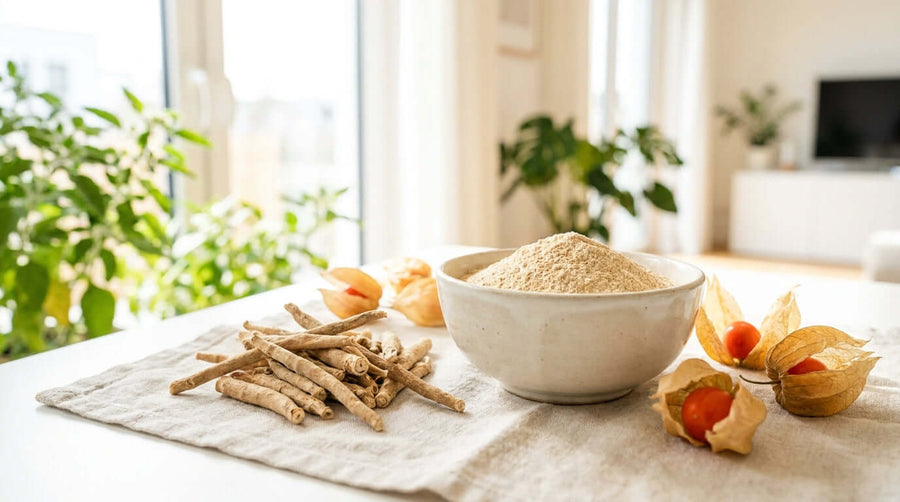
Ashwagandha (Withania somnifera) is a small, hardy plant. Botanically, it belongs to the nightshade family (Solanaceae). It originally comes from the dry regions of India, Pakistan, and Sri Lanka. In German, it has many names: sleep berry, winter cherry, or Indian ginseng. The part mainly used is the root, because that is where the valuable plant compounds are found.
The name Ashwagandha comes from Sanskrit and roughly means "smell of a horse." In Ayurvedic tradition, it has been considered an important medicinal plant for thousands of years. This long history makes Ashwagandha one of the best-documented plants in Ayurveda.
Ingredients: withanolides and other plant compounds
The characteristic ingredients in Ashwagandha are the withanolides. These are secondary plant compounds found mainly in the root extract. High-quality extracts are standardized to a fixed withanolide content. This keeps the active ingredient content comparable from batch to batch.
In addition to the withanolides, the plant contains other natural compounds. For the quality of a product, the standardized withanolide content is especially important.
What does KSM-66 mean in Ashwagandha?
KSM-66 is a patented full-spectrum extract made exclusively from the root, not the leaves. It is produced without chemical solvents. Our Ashwagandha KSM-66 provides 600 mg of extract per capsule with at least 5 percent withanolides. The raw material is high quality and especially well studied.
Ashwagandha effect: What does research say about its effects?
Many people are interested in the effects of Ashwagandha. An honest classification is important here. No health claims are currently authorized for Ashwagandha in the EU. That means: we cannot and do not want to promise any specific effect. What we can do is describe its traditional use and the current state of research.
Ashwagandha in Ayurvedic medicine
In Ayurvedic medicine, Ashwagandha is classified as a "Rasayana." Rasayana refers to substances traditionally associated with vitality and regeneration. Old texts such as the Charaka Samhita say that the root should help the body cope with the stresses of everyday life. These statements come from tradition and are not scientifically proven effects.
Positive effects: What studies are currently examining
Modern research has been focusing intensively on Withania somnifera for several years. Several controlled studies have examined the influence of Ashwagandha on perceived stress and sleep quality. Some studies suggest that Ashwagandha could influence subjective stress levels. However, a positive effect in individual studies does not mean that these results apply to everyone or can be considered established.
The study situation is interesting, but not yet conclusive. Whether you experience an effect is individual. Many studies are small or short-term. No authorized health claim can be derived from this. If you want to dig deeper, you will find the most important sources at the end of this guide.

The correct way to take Ashwagandha
Taking Ashwagandha is straightforward. The easiest way is with a high-quality capsule. Take it with enough liquid and with a meal. Regular use over several weeks is especially important.
Dosage and use: When and how much?
How much Ashwagandha makes sense depends on the product. For our KSM-66, one capsule per day is usually enough. Many people take Ashwagandha in the morning with breakfast or in the evening. Whether morning or evening is better depends on the individual.
- Morning: with breakfast and some liquid
- Evening: one to two hours before going to bed
- Always: regularly for at least four to eight weeks
The correct dosage of Ashwagandha extract
The right amount always depends on the recommended intake on the package. With standardized extracts, the dose is already optimally set. You should not exceed the stated daily intake. More does not mean better. Consistency is key.
Ashwagandha as capsules or powder?
Ashwagandha is available as capsules and as Ashwagandha powder. Both forms have their advantages. Powder can be dosed flexibly, but it tastes quite strong and earthy. Capsules are tasteless, precisely dosed, and practical for on the go. The capsule shell we use is purely plant-based (HPMC).
Feature |
Capsules |
Powder |
Dosage |
Pre-dosed precisely |
Must be measured out yourself |
Taste |
Taste-neutral |
Strong and earthy |
Everyday use |
Practical for on the go |
Better for home use |
Side effects, interactions, and safety
Ashwagandha is considered well tolerated when used properly. Still, there are a few points you should know about tolerability. This is especially true if you take medication or have pre-existing conditions.
Ashwagandha side effects: What you should know
A serious side effect of Ashwagandha is rare. In isolated cases, users report gastrointestinal complaints. These include nausea, diarrhea, or a feeling of pressure in the stomach. These symptoms usually occur only at the beginning or with a high dose. If you are unsure, speak with your doctor.
Interactions with medication
Ashwagandha may interact with certain medications. Possible effects are discussed, including those with thyroid preparations, sedatives, and products that affect the immune system. If you take medication regularly, consult your doctor or pharmacist before using it.
Who is Ashwagandha not suitable for?
Not everyone should take Ashwagandha. Pregnant and breastfeeding women should avoid the plant. Ashwagandha is also not suitable for children and adolescents. If you are pregnant or have a thyroid disorder, seek medical advice first.
Does Ashwagandha lead to weight gain?
A common question is whether Ashwagandha affects body weight. There is currently no reliable evidence of a direct connection. Ashwagandha itself provides hardly any calories. If you are watching your weight, you should focus mainly on diet and exercise.

Ashwagandha as a dietary supplement from Vitalplant
Our Ashwagandha KSM-66 is a dietary supplement made from pure root extract. We produce it in our factory in Memmingen. Every batch is tested by independent laboratories. It is vegan, free from unnecessary additives, and provides a standardized withanolide content.
Many people combine Ashwagandha in the evening with magnesium. Magnesium contributes to normal nervous system function and normal psychological function. This is a sensible way to combine traditional knowledge with an authorized nutrient.
Related topics
- All plant extracts at a glance
- Stress, sleep & nerves topic world
- More knowledge in the Vitalplant magazine
Note: Dietary supplements are not a substitute for a varied, balanced diet and a healthy lifestyle. No health claims are currently authorized for Ashwagandha in the EU.

Frequently asked questions about Ashwagandha
How quickly does Ashwagandha work?
It is not possible to give a reliable fixed time. In studies, observations were often made only after several weeks of regular use. So give it a few weeks.
When should you take Ashwagandha, in the morning or evening?
It depends on the individual. Some prefer the morning, others the evening. Above all, consistency over several weeks is important.
How much Ashwagandha should you take per day?
Follow the recommended intake on the package. With standardized extracts like KSM-66, one capsule per day is usually enough.
Does Ashwagandha have side effects?
Ashwagandha is considered well tolerated. Gastrointestinal complaints such as nausea occur rarely. If you are unsure, ask your doctor.
Does Ashwagandha interact with medication?
Possible effects with thyroid medication and sedatives are possible. If you are taking medication, you should clarify this with a doctor in advance.
Is Ashwagandha suitable during pregnancy?
No. Pregnant and breastfeeding women should avoid Ashwagandha.
Do you gain weight from Ashwagandha?
There is no reliable evidence of a direct connection with body weight.
Capsules or powder, which is better?
The capsule is precisely dosed and tasteless. Ashwagandha powder is more flexible, but tastes strong and earthy.
Is Ashwagandha a medication?
No. Ashwagandha is a dietary supplement and is not intended to treat diseases.