Vitamin B12 Capsules

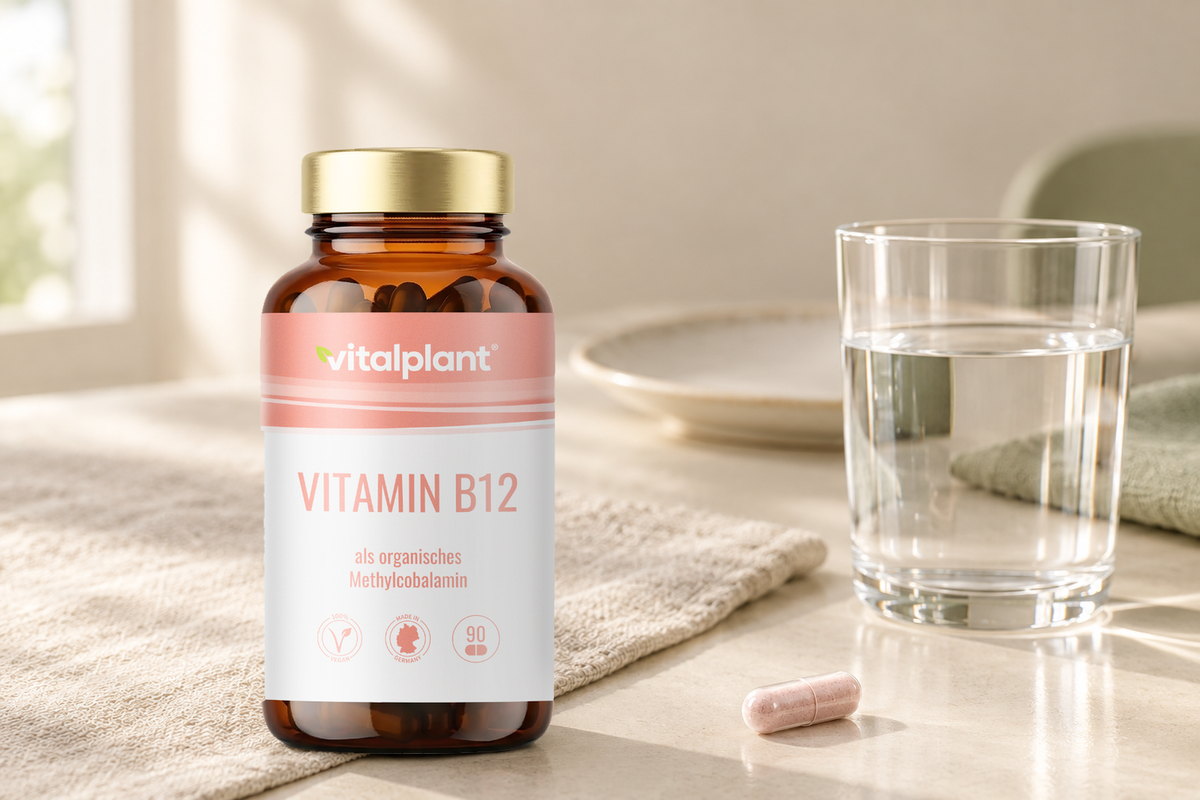
Vitamin B12 capsules provide 1.25 mg of vitamin B12 as methylcobalamin per daily dose, supplemented with 400 mg buckwheat sprout extract. Vitamin B12 contributes to normal energy metabolism. 90 capsules for 90 days. Lab-tested from the pharmacist's manufactory in Memmingen.

€19,90

€450,23 kg
Tax included.
Shipping calculated at checkout.

In stock - Arrives in 2-3 working days!

Size: 90 capsules

Pay securely with PayPal Klarna Visa Mastercard Apple Pay Google Pay American Express

All payment methods

  • PayPalPayPal
  • KlarnaKlarna
  • Visa Visa
  • Mastercard Mastercard
  • Apple Pay Apple Pay
  • Google Pay Google Pay
  • American Express American Express
  • BizumBizum
  • EPS eps
  • iDEAL WeroIdeal
  • MaestroMaestro
  • Shop Pay Shop Pay
  • Union PayUnionPay

Payment is SSL encrypted via Shopify Checkout.

1.25 mg vitamin B12 per capsule

One capsule provides 1,250 µg vitamin B12 as methylcobalamin. That is 500 times the nutrient reference value of 2.5 µg, declared on the label as 50,000 percent. Such a magnitude is common with vitamin B12, but it does deserve an explanation.

Why neither animals nor plants produce B12

Vitamin B12 is chemically called cobalamin, and the name is meant literally: a cobalt ion sits at the center of the molecule. No other vitamin contains a metal.

It is formed exclusively by bacteria and archaea. Neither a plant nor an animal can do this, and neither can humans. Ruminants get their B12 because the corresponding bacteria live in their rumen; through meat, fish, eggs, and milk, it then enters the human diet. People who eat a plant-based diet do not have this detour available.

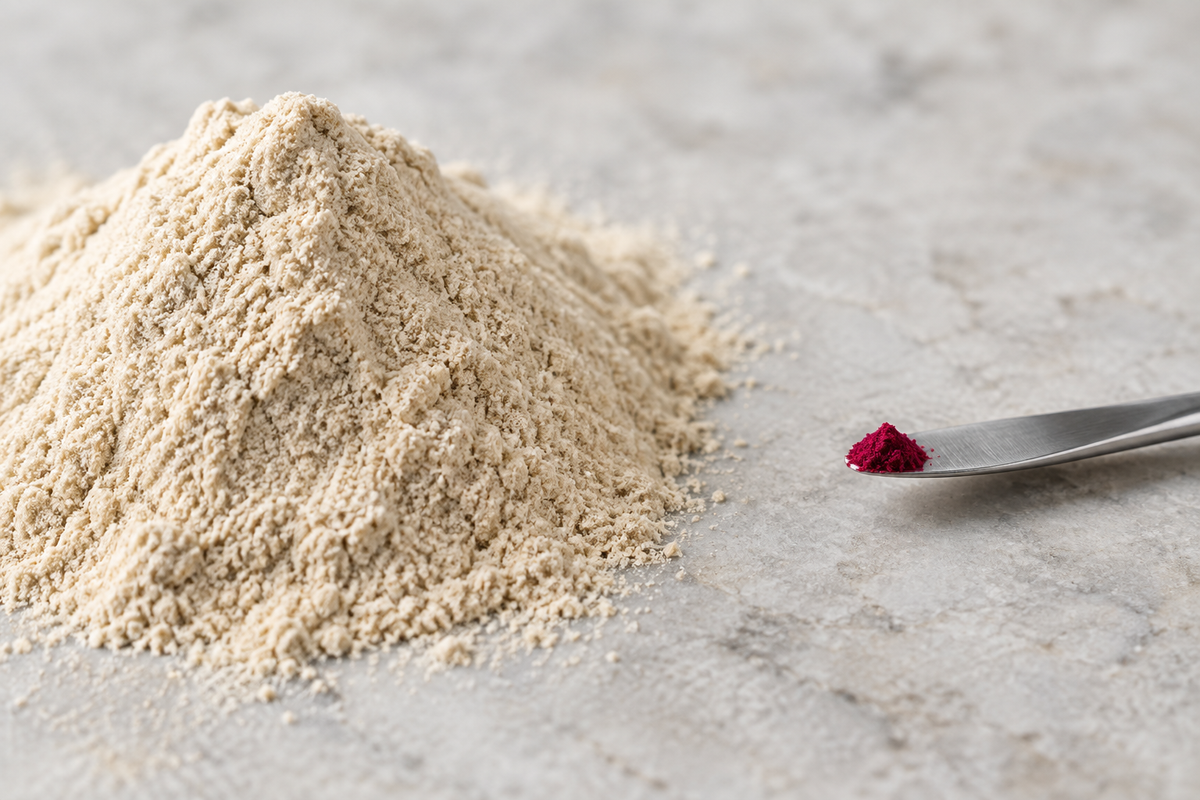
The buckwheat sprout extract in this formula does not supply the vitamin; it carries it. By the way, buckwheat is not a grain, but a knotweed plant, and is therefore more closely related to rhubarb and sorrel than to wheat.

Methylcobalamin, and why the dose is so high

Supplement products usually contain two forms. Cyanocobalamin is the synthetic, especially shelf-stable variant, in which a cyanide group sits on the cobalt and must first be replaced by the body. Methylcobalamin is, on the other hand, one of the two forms in which the vitamin actually works in metabolism.

The level of the dosage has to do with absorption. B12 has its own transport pathway via a binding protein from the gastric mucosa. This pathway works very efficiently, but it is limited: only a few micrograms can be absorbed this way per meal, after which it is saturated. Anything beyond that reaches the body only through passive diffusion, and about one percent is absorbed. High-dose products are aimed at this second route.

The approved claims are based on 15 percent of the nutrient reference value, a threshold that is far exceeded here: Vitamin B12 contributes to the normal function of the nervous system, to normal red blood cell formation, and to the reduction of tiredness and fatigue. It also has a role in cell division.

Composition and quality

Three ingredients, nothing more: buckwheat sprout extract, methylcobalamin, and the capsule shell made of hydroxypropyl methylcellulose. No anti-caking agents, no fillers, no colorants. The formula is purely plant-based and therefore vegan.

It is bottled in amber glass. This is no minor detail with B12, because cobalamins are sensitive to light, and brown glass largely blocks UV light.

Vitalplant is backed by Christian Lazar, a licensed pharmacist with over 35 years of professional experience at Stern Apotheke.

Inhalte zuletzt geprüft am

Buckwheat sprout powder, methylcobalamin, veg. capsule shell: hydroxypropylmethylcellulose

Recommended use: Take 1 capsule daily, unchewed and with sufficient liquid, approx. 30 min before a meal.

Important notes: Food supplements are not a substitute for a balanced and varied diet and lifestyle. The stated recommended daily intake must not be exceeded. Keep out of reach of small children.

Allergens: According to the raw material specification, contains no allergens subject to mandatory labeling pursuant to Annex II of Regulation (EU) No. 1169/2011.

Storage: Store in a cool, dry place, do not freeze, and protect from direct sunlight.

The Largest Vitamin Molecule

Cobalamin is by far the largest and most complex of all vitamins. At its center sits a cobalt ion, enclosed in a corrin ring made up of four nitrogen units. It took decades to unravel this structure: the British crystallographer Dorothy Hodgkin succeeded in 1956 using X-ray crystallography, for which she received the Nobel Prize in Chemistry in 1964. The complete chemical synthesis in the lab followed only in 1972 and is still considered one of the most complex ever carried out.

Four forms, two of them active

A varying group can sit on the cobalt, and the forms differ accordingly. Cyanocobalamin carries a cyanide group there; it is the most stable and least expensive variant and therefore the most widely used in supplements. Hydroxocobalamin carries a hydroxyl group.

Methylcobalamin and adenosylcobalamin, by contrast, are the two forms in which the vitamin actually functions as a coenzyme in metabolism. In this formula, methylcobalamin is used.

Where the raw material comes from

Vitamin B12 for supplements is not isolated from animal sources, but produced through bacterial fermentation. Bacterial strains that naturally form the molecule are used for this purpose. The process takes place in closed fermenters, after which the cobalamin is separated from the culture broth and purified. In practical terms, this means B12 from supplements is independent of animal raw materials.

What the reference values mean

The packaging states the nutrient reference value, defined in Annex XIII of the Food Information Regulation. For vitamin B12, it is 2.5 µg. It serves to make products comparable and is not a nutritional target.

There are also two other values that are often confused. The German Nutrition Society names an estimated intake value, which is higher at 4.0 µg per day. And the EFSA derives a tolerable total intake level for many nutrients; for vitamin B12, it has so far not set one due to a lack of data. Three numbers, three different purposes.

Our Vitamin B12 capsules are manufactured to the highest quality standards and independently tested for heavy metals.

✔
Laboratory analysis - Download here!
✔ Product specification - Download here!

Vitamin B12 Capsules

€19,90

€450,23 kg

€19,90

€450,23 kg

Drei Angaben zur Kapsel

  • Vitamin B12 Kapseln - B12 als Methylcobalamin

    B12 als Methylcobalamin

  • Vitamin B12 Kapseln - 1.250 µg je Kapsel

    1.250 µg je Kapsel

  • Vitamin B12 Kapseln - Täglich 1 Kapsel vor dem Essen

    Täglich 1 Kapsel vor dem Essen

Product reviews

Aus eigener Herstellung

  • Christian Lazar, Apotheker bei Vitalplant
    Vom Apotheker entwickelt Christian Lazar stellt jede Rezeptur selbst zusammen.
  • Pulver wird von Hand über die Kapselplatte abgestrichen
    Von Hand abgefüllt Kleine Chargen, jede Platte einzeln abgestrichen.
  • Kapselfüllgerät in der Herstellung
    Mechanisch dosiert Gleiche Menge in jeder einzelnen Kapsel.
  • Ohne künstliche ZusätzeKeine künstlichen Süßstoffe, Aromen oder Farbstoffe.
  • Geprüfte RohstoffeUnabhängig laborgeprüft, Analysenzertifikat auf jeder Seite.
  • Lichtgeschützt verpacktBraunglas oder blickdichter Beutel, je nach Produkt.
  • Kurze ZutatenlisteWas nicht hineingehört, steht auch nicht drin.

Frequently Asked Questions

Take one capsule daily, swallowed whole with plenty of liquid, about 30 minutes before a meal. That's all there is to it. The easiest way is to link taking it to a regular meal, usually breakfast.

Vitamin B12 from food is bound to proteins and must first be released in the stomach. Methylcobalamin from a capsule, by contrast, is already in free form and does not need this step. The time gap from the meal gives it a proven path and a fixed place in the routine.

Es ist eine bewusst hohe Dosierung: 1,25 mg entsprechen 1.250 µg und damit 50.000 Prozent der Nährstoffbezugsmenge. Der Hintergrund liegt in der Aufnahme. Der Körper besitzt für B12 einen eigenen Transportweg über ein Bindungsprotein aus der Magenschleimhaut. Der arbeitet sehr effizient, ist aber begrenzt und pro Mahlzeit nach wenigen Mikrogramm gesättigt. Alles darüber gelangt nur noch durch passive Diffusion hinein, und dabei kommt etwa ein Prozent an. Auf diesen zweiten Weg zielen hochdosierte Präparate.

Cyanocobalamin is the synthetic, especially shelf-stable variant, in which a cyanide group is attached to the central cobalt atom; the body must first replace it. Methylcobalamin, on the other hand, is one of the two forms in which the vitamin actually works in metabolism. In our range, you can also find methylcobalamin in Vitamin B Complex Aktiv and cyanocobalamin in Forte.

Because only bacteria and archaea can produce it. No plant or animal can do that, including humans. Ruminants get their B12 because the corresponding bacteria live in their rumen; through meat, fish, eggs, and milk, it then enters the human diet. Those who eat a plant-based diet do not have this route available.

Vitamin B12 contributes to the normal function of the nervous system, to normal red blood cell formation, to the reduction of tiredness and fatigue, to a normal energy-yielding metabolism, and to normal psychological function. It also has a role in cell division.

It serves as a plant-based carrier with 400 mg per capsule and is what fills it in the first place, because 1.25 mg of methylcobalamin on its own would be a barely visible crumb. Despite its name, buckwheat is not a grain, but a knotweed plant and thus more closely related to rhubarb and sorrel than to wheat. Naturally gluten-free.

The bottle contains 90 capsules and, at one capsule per day, lasts exactly 90 days, or a quarter of a year. The formula is purely plant-based and therefore vegan. It is packaged in amber glass, which is no minor detail when it comes to B12: cobalamins are sensitive to light.

General ratings from our customers