


lion's mane
The lion's mane mushroom is in everyone’s mouth in 2026 for good reason: Named Mushroom of the Year 2026, Hericium erinaceus is drawing the attention of naturalists, researchers, and people looking for high-quality natural dietary supplements. This fascinating functional mushroom is by no means new: in North America and Asia, it has been valued for centuries both as an edible mushroom and as a medicinal mushroom, and modern mushroom research is confirming interest in it with growing scientific evidence.
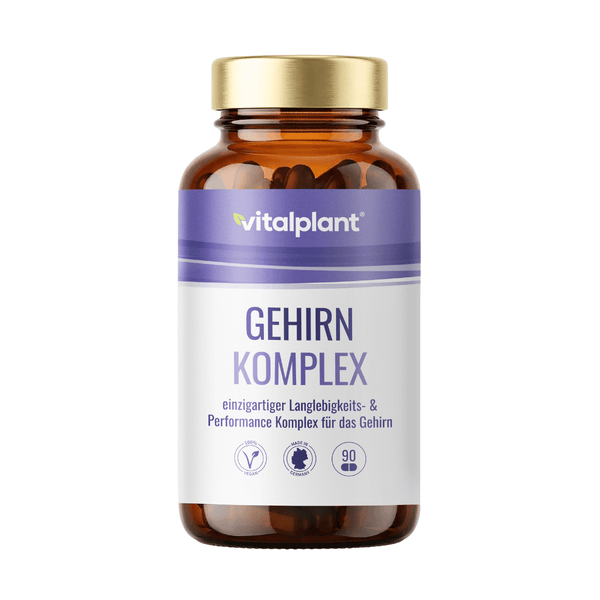
Brain Complex – The natural formula for mental clarity & focus Disc...
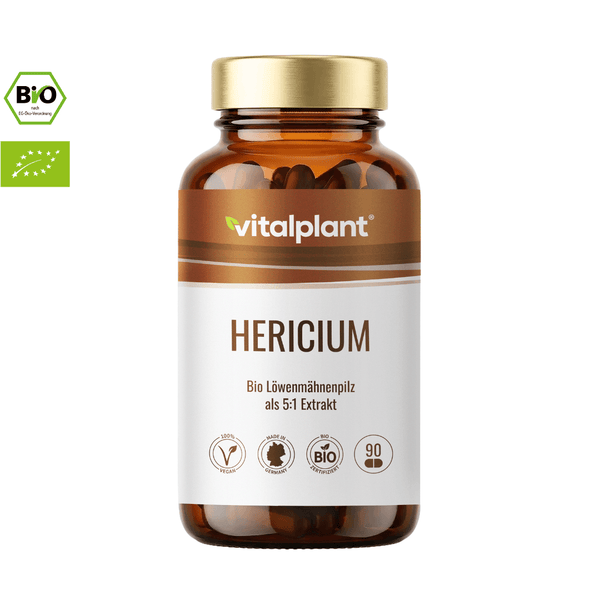
Organic Lion's Mane Mushroom Capsules – Hericium in certified organ...
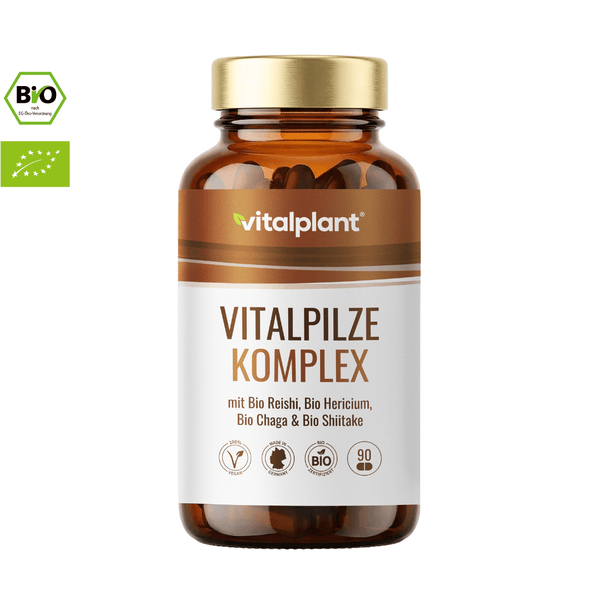
Organic Medicinal Mushroom Complex Capsules – Four selected mushroo...
Das solltest du über lion's mane wissen
Alles über lion's mane
Lion's Mane (Hericium erinaceus): Explaining the Organic Medicinal Mushroom of the Year 2026
Whether you know it as Lion's Mane, monkey head mushroom, Yamabushitake, or Pom Pom Blanc: all of these names refer to the same extraordinary mushroom, whose shaggy, tufted appearance immediately catches the eye and whose unmistakable shape makes it one of the most fascinating edible and medicinal mushrooms of all. At Vitalplant, you'll learn what makes Hericium erinaceus so special as a dietary supplement, which compounds it contains, what traditional Chinese medicine and current research say about it, and what to look for when buying organic Hericium products.
What is Lion's Mane? Hericium erinaceus as a gourmet and medicinal mushroom
Lion's Mane (Hericium erinaceus) is a mushroom from the Hericiaceae family that grows in the wild on deadwood in old deciduous forests, preferably on oak, beech, and walnut trees. Its cream-colored to white fruiting body is rounded, oval, or heart-shaped and covered with long, hanging spines, each individual spine bearing spores. This unique appearance gave it its German name: the mushroom really does look like a puffed-up hedgehog or, indeed, a lion's mane.
As both a gourmet mushroom and a cultivated and medicinal mushroom, Hericium erinaceus has been known in Asia for centuries. In Europe and Germany, it is still less common as an edible mushroom, but it is rapidly gaining recognition as a medicinal mushroom in dietary supplements. Hericium erinaceus occurs naturally in deciduous forests, but as a wild mushroom it is rare and listed as endangered. Its wild populations are so severely threatened that they must be protected for conservation reasons. Anyone wishing to use it therefore depends on products from sustainable, controlled cultivation.
The term mushroom species describes a very distinct ecology: Hericium erinaceus is exotic enough to inspire amazement here, yet its roots lie in a tradition thousands of years old. In Asia, it is also known as monkey head mushroom or Yamabushitake, in France as Pom-Pom Blanc or Pom Pom Blanc, and in English as Lion's Mane. All these names point to the same thing: a mushroom of extraordinary shape and equally extraordinary potential.
Hericium compounds: What's in the fruiting body of Lion's Mane?
What makes Hericium erinaceus so interesting as a medicinal mushroom is its bioactive compounds. Research has studied Hericium erinaceus intensively over recent decades, and the picture emerging is impressive. That said: none of the following information should be understood as an authorized health claim within the meaning of the HCVO. We present the scientifically studied compounds objectively.
Hericenones and erinacines
The two best-known groups of active compounds in Hericium erinaceus are hericenones and erinacines. Hericenones are found primarily in the fruiting body, while erinacines are mainly produced in the mycelium. Both compounds are at the center of current neurobiological research. Scientists around the world are studying them in the field of neurobiology and exploring their possible role in cognitive functions. It should be explicitly emphasized: this is ongoing research, not health promises.
Polysaccharides and beta-glucans
Like all important medicinal mushrooms, Hericium erinaceus contains polysaccharides, especially beta-glucans. These long-chain carbohydrate molecules are a natural component of the mushroom's cell wall and are among the characteristic compounds of high-quality medicinal mushrooms. A high-quality organic Hericium extract should be standardized for its polysaccharide content so you know what you're really taking.
Vitamins and other bioactive compounds
The fruiting body of Hericium erinaceus contains naturally occurring sterols and amino acids as well as vitamin B6 and vitamin B12 - vitamin B6 contributes to normal energy metabolism, and vitamin B12 contributes to the normal function of the immune system. This makes Hericium erinaceus a natural source of various nutrients and means it goes far beyond a single class of active compounds.
Hericium erinaceus in Traditional Chinese Medicine: Used for centuries
In traditional Chinese medicine (TCM), Hericium erinaceus is known as "Hou Tou Gu," which explains its nickname monkey head mushroom. As an edible mushroom, it has been an integral part of East Asian cuisine for centuries and is traditionally used in TCM to support the digestive system. Even today, people in Asia value it as a versatile culinary mushroom with a long culinary tradition.
In Japan, it was known as Yamabushitake, named after the ascetic Yamabushi monks who used it as part of their practice. Hericium erinaceus has a long tradition in Japanese cuisine and natural medicine - an edible mushroom that has been valued in Asia for centuries. What folk medicine described intuitively is now being systematically investigated by modern science: the biologically active compounds of Hericium erinaceus are the subject of numerous preclinical and clinical studies whose results are attracting worldwide attention.
This dual grounding in a tradition thousands of years old and in modern research makes Hericium erinaceus one of the most important representatives among medicinal mushrooms. It is not a trend product, but a natural dietary supplement with a genuine historical and scientific background.
Mushroom of the Year 2026 and organic cultivation: Why Lion's Mane is rare
Its designation as Mushroom of the Year 2026 by the German Society for Mycology is an award with a message. Hericium erinaceus is rare in nature: its wild populations in near-natural deciduous forests have been severely decimated by the decline of old tree populations and intensive forestry. In Germany, the species is considered highly endangered and is listed as threatened. Wild specimens may therefore not be collected.
For anyone who wants to use Lion's Mane as a medicinal mushroom, the rule is therefore: only products from controlled, certified cultivation are a sustainable choice. Modern cultivation takes place on organic substrates under controlled conditions with constant humidity and suitable temperatures. Stable humidity is crucial for the optimal development of the full fruiting body. This carefully cultivated organic Hericium erinaceus matches the wild mushroom in quality and compounds while also relieving pressure on threatened natural populations.
Certified organic cultivation also means that no chemically synthetic pesticides are used. This is especially important with mushrooms: mushrooms are known to accumulate pollutants from their environment, which is why origin and growing conditions are more crucial here than with almost any other medicinal mushroom. So when buying organic Hericium erinaceus, be sure to look for verified organic certification and transparent origin information.
Buying Lion's Mane: What to look for in quality and purity
The market for Hericium products has grown sharply in recent years, and with it the differences in quality. So that you really get what the label promises, we've summarized the most important criteria for you.
Fruiting body or mycelium: The key difference
High-quality Hericium products are based either on the fruiting body, the mycelium, or a combination of both. Since hericenones are mainly found in the fruiting body and erinacines in the mycelium, a high-quality preparation should clearly state its fruiting body and mycelium content. Products that fail to provide this information should be treated with caution.
Standardized polysaccharide content
Look for documented polysaccharide content. Reputable manufacturers standardize their extract and state the beta-glucan content on the packaging. This information allows an objective comparison between products and stands for real transparency.
Organic certification and origin
A certified organic Hericium erinaceus from controlled cultivation is the only sustainable choice. Look for a recognized organic seal and clear origin information. Mushrooms accumulate pollutants especially efficiently, making cultivation quality the absolute key factor.
No unnecessary additives
A high-quality dietary supplement with Hericium erinaceus does not need fillers, binders, or flow agents such as magnesium stearate. Purity is not a bonus, but the bare minimum you should expect from a premium medicinal mushroom product.
Lab-tested purity
Every batch should be analytically tested in the lab for purity and active compound content. A manufacturer that does this and communicates it transparently has nothing to hide and everything to gain.
Organic Lion's Mane capsules from Vitalplant: Premium organic Hericium erinaceus with high standards
Our Vitalplant Organic Lion's Mane Capsules offer you Hericium erinaceus in the quality you would expect from a family-run manufacturer in Memmingen: consistently organically certified, without magnesium stearate and other unnecessary excipients, in plant-based cellulose capsules, 100% vegan, and laboratory tested.
What sets our Organic Lion's Mane Capsules apart is our clear philosophy: no compromises on raw material quality, no shortcuts in processing, no ambiguity about origin and composition. Every batch that leaves our facility is tested. For us, that's a matter of course - and for you, the decisive difference compared with many products on the market.
Use is very simple: take the recommended daily amount with sufficient water, ideally with a meal. As with all medicinal mushrooms, the same applies to Hericium erinaceus: consistency is key. In TCM and natural medicine, Hericium erinaceus is traditionally used daily over a longer period - so regular intake as part of a balanced diet is the approach rooted in the tradition of this mushroom.
If you'd like to benefit from the full spectrum of medicinal mushrooms, it's also worth taking a look at our Organic Medicinal Mushroom Complex, which combines Hericium erinaceus with Reishi, Cordyceps, and other medicinal mushrooms in a single product.
→ Discover the Vitalplant Organic Medicinal Mushroom Complex
Lion's Mane compared: Hericium, Reishi, and Cordyceps as medicinal mushrooms
Hericium erinaceus does not stand alone. Among the most important medicinal mushrooms, it occupies a very distinctive position, as its bioactive profile differs significantly from that of its best-known relatives.
Reishi (Ganoderma lucidum) is the "king of medicinal mushrooms" with the broadest historical heritage and a wide spectrum of polysaccharides and triterpenes. Cordyceps sinensis, the caterpillar fungus, is a medicinal mushroom traditionally used in East Asia and contains the compounds cordycepin and adenosine. Of the three, Hericium erinaceus alone contains hericenones and erinacines - unique compounds that are natural components of this mushroom and are currently the subject of scientific investigation.
The combination of these three medicinal mushrooms has long been known in TCM and is also deliberately used in modern dietary supplements. If you don't want to combine them individually, the Vitalplant Organic Medicinal Mushroom Complex offers a practical and balanced solution.
Fresh Lion's Mane: The edible mushroom in the kitchen
Although this guide focuses on Hericium erinaceus as a medicinal mushroom and dietary supplement, it's worth taking a brief look at its culinary side. Hericium erinaceus is also a true delicacy as an edible mushroom: fresh, it has a mild, slightly sweet aroma with a texture reminiscent of tender meat or seafood. Not without reason is it sometimes compared in taste to lobster. It is excellent for frying in butter, as a side dish, or in soup.
As a powder or extract, it can also be stirred into smoothies, soup, or warm drinks, making the transition between capsule form and culinary use a natural one. The capsule form offers a practical and consistent way to conveniently integrate Hericium erinaceus extract into everyday life.
Conclusion: Lion's Mane as a medicinal mushroom for everyday life
Hericium erinaceus is one of the most fascinating medicinal mushrooms in the world: rare in nature, deeply rooted in TCM, increasingly studied by modern science, and remarkable for its natural nutritional profile - with mushroom-specific compounds such as hericenones and erinacines as well as beta-glucans and vitamins. No wonder it was chosen as Mushroom of the Year 2026.
If you want to integrate the unique properties of Lion's Mane into your everyday life, you don't need a fresh specimen from a specialty retailer. With Vitalplant Organic Lion's Mane Capsules, you get Hericium erinaceus in organic quality, laboratory tested, without magnesium stearate, and delivered directly to your home with free shipping from 60 €. This is the easiest and most reliable way to integrate this mushroom into your daily routine.
Telefonische Bestellung unter:
+49 8331 - 9258811
Mo-Fr, 08:00 - 12:00 Uhr
Oder über unser Kontaktformular.
Telefonische Bestellung unter:
+49 8331 - 9258811
Mo-Fr, 08:00 - 12:00 Uhr
Oder über unser Kontaktformular.
