Haare

Zinc – a jack-of-all-trades among minerals

Zinc contributes to the normal function of the immune system and the maintenance of normal skin: where to find it and how much you need.

•Zuletzt geändert am • 12 min Lesezeit • Fachlich geprüft von Dr. Anna Falk am
Zinc - a jack-of-all-trades among minerals, shown by foods like meat, vegetables and nuts.

Zinc plays an important role in our daily lives and is a Mineral, which we encounter very often in everyday life. Yet we often overlook it or fail to appreciate its versatility. Zinc plays a particularly important role in Protection against corrosion in, for example with watering cans, metal frames or car bodies.

Zinkkapseln auf einem Holzlöffel mit gesunden Gemüse im Hintergrund

Even with rechargeable batteries zinc is used on a large scale and, thanks to its galvanic properties, is a very popular material in battery manufacturing.

Even as a Coins zinc alloys were used and are still used today in the US cent as the core to find.

We want to take a closer look here at the properties of zinc that are relevant to our Health is priceless are!

Das Wichtigste in Kürze

  • Zink ist ein essenzielles Spurenelement und Bestandteil von mehr als 300 Enzymen.
  • Der Körper kann Zink kaum speichern, deshalb kommt es auf die tägliche Zufuhr an.
  • Die DGE empfiehlt Männern 11 bis 16 mg und Frauen 7 bis 10 mg Zink pro Tag, je nach Phytatzufuhr.
  • Am meisten Zink liefern Austern, Weizenkeime, Kerne, Fleisch, Käse und Hülsenfrüchte.
  • Die EFSA nennt 25 mg Zink pro Tag aus allen Quellen als Obergrenze für Erwachsene.

Nothing works without zinc!

The wide range of processes in which zinc is involved in our bodies makes it a essential trace element. This means that many bodily functions depend on zinc and cannot work without this mineral.

Enzymes and metabolism

Frau hält ein Model eines Magens als Zeichen für den Stoffwechsel

As essential coenzyme is zinc a component of more than 300 enzyme systems, which, among other things, for the Energy production and supply, protein, fat and carbohydrate metabolism as well as for the Bone metabolism and detoxification are responsible.

Zinc contributes to normal protein synthesis, normal carbohydrate and fatty acid metabolism, and normal macronutrient metabolism!

Antioxidant effect

Zinc is an essential mineral component of the so-called Superoxide dismutase, abbreviated SOD. This is an enzyme that is found in the Red blood cells occurs and Oxygen radicals removed. Oxygen radicals play a role in various diseases, such as in Joint diseases or eye diseases, as well as when Aging process a role.

Zinc helps protect cells from oxidative stress!

Zinc and the immune system

Das Produkt Zink25 von Vitalplant mit einem Schutzschild als Zeichen für Immunität

As a general rule, any deficiency in essential nutrients weakens the immune system, but experts unanimously agree that Zinc is the most important trace element in this context represents.

To name just a few of the functions important for the immune system, these include the influence of zinc on the Production and activity of white blood cells (T lymphocytes), thymus function and the associated Hormone release and his antiviral properties mentioned.

Zinc contributes to the normal function of the immune system!

Zinc for Skin and Wound Healing

Eine Frau strahlt voller Freude und hat makellose, schöne Haut

That zinc the Protein synthesis influenced, has already been mentioned. The biological processes associated with protein synthesis have a direct impact on our Skin and its ability to regenerate.

In connection with Skin conditions several studies have already found that the diseases are associated with a Zinc deficiency can be associated with.

It is therefore no surprise that zinc also has a positive effect on the Wound healing has. In this context, everyone is likely familiar with the use of Zinc ointments be known for minor injuries or skin lesions.

Zinc helps maintain normal skin, hair and nails!

Zinc and Vision

Ein Mann mit gestochen scharfen Augen als Symbol für Sehkraft

As mentioned earlier, zinc is an essential component of the cell-protecting antioxidant enzyme Superoxide dismutase, which protects cells throughout the body from free radical damage. Particularly vulnerable in this regard is the Eye.

The cells of eye tissue can be particularly severely damaged by these radicals. In patients who suffer from Cataract have fallen ill, a was often low blood zinc level identified, which is one contributing factor to impaired glucose metabolism in the lens. A link to a deficiency in retinal zinc and Macular degeneration could also be confirmed. Clinical studies have shown that a Zinc supplementation reduces vision loss can be.

Zinc helps maintain normal vision!

Zinc and Muscles

Zwei starke Arme von Männern als Zeichen für Muskelaufbau

Athlete are generally aware of zinc's important functions. This awareness is well founded. In fact, zinc also plays a role in our Muscles a very important role, especially during physical activity. As we have already learned, zinc plays an extremely important role in metabolic processes, especially with the Energy supply and delivery to the muscles.

As a trace element, it also plays a key role in the Regeneration and formation of new muscle cells involved. It is also important to note in this context that muscle cells are particularly susceptible to increased metabolic activity during exercise, making them vulnerable to Oxygen radicals are produced in greater quantities during intense muscular exertion. These can be neutralized by zinc.

But zinc can do so much more!

Zinc contributes to the maintenance of normal testosterone levels in the blood!

Zinc contributes to normal fertility and reproduction (reproductive capacity)!

Zinc contributes to normal cognitive function!

Zinc contributes to the maintenance of normal bones!

Zinc contributes to normal acid-base metabolism!

Zinc contributes to normal vitamin A metabolism!

Zinc contributes to normal DNA synthesis!

Our Verdict

Zinc has a invaluable for our health and is needed by our body for a wide range of functions. Since zinc is absorbed by the body only saved poorly can be, particular importance must be placed on an adequate intake of zinc!

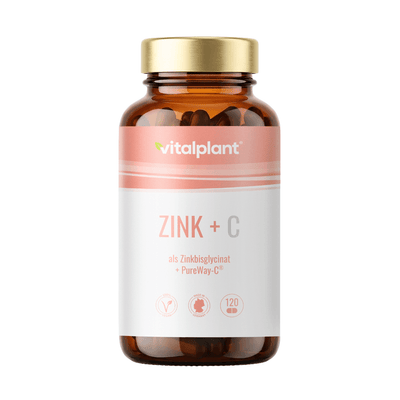
Perfectly measured-out Capsules with Zinc + Vitamin C for your overall well-being, to support your immune system or your vision, you'll find it here:

Die Zink + Vitamin C Kapseln von Vitalplant in braunem Apothekerglas

If you're interested in zinc as part of a comprehensive formula for Skin, Hair and Nails interested, then you'll find what you're looking for here:

Der Haut Haare Nägel Komplex von Vitalplant

Chat in our Community about your experiences with zinc or other dietary supplements, feel free to ask questions or learn from the experiences of other community members!

Häufig gestellte Fragen

Wofür ist Zink gut?

Zink ist Bestandteil von mehr als 300 Enzymen. Es trägt unter anderem zu einer normalen Funktion des Immunsystems bei, zur Erhaltung normaler Haut, Haare und Nägel, zu einer normalen kognitiven Funktion, zur Erhaltung normaler Sehkraft und dazu, die Zellen vor oxidativem Stress zu schützen.

Welche Lebensmittel enthalten am meisten Zink?

Am meisten Zink liefern Austern, danach folgen Weizenkeime, Hanfsamen, Kürbiskerne, Sesam, Rindfleisch, Cashewkerne, Hartkäse und Hülsenfrüchte. Aus tierischen Lebensmitteln nimmt der Körper Zink in der Regel besser auf als aus pflanzlichen.

Wie viel Zink braucht man am Tag?

Die DGE empfiehlt Männern je nach Phytatzufuhr 11 bis 16 mg und Frauen 7 bis 10 mg Zink pro Tag. Wer viel unbehandeltes Vollkorn und Hülsenfrüchte isst, braucht mehr, weil die Phytinsäure darin Zink bindet.

Soll man Zink morgens oder abends einnehmen?

Die Tageszeit ist weniger wichtig als der Abstand zu Mahlzeiten und anderen Präparaten. Nüchtern wird Zink am besten aufgenommen, kann aber Übelkeit auslösen. Viele nehmen es abends, weil dann der Abstand zu Eisen- oder Calciumpräparaten vom Morgen groß ist.

Was ist ein Zinkräuber?

So nennt man Stoffe, die die Zinkaufnahme hemmen oder den Zinkspiegel senken: Phytinsäure aus Vollkorn und Hülsenfrüchten, Eisen und Calcium in hohen Dosen, Alkohol sowie bestimmte Medikamente wie Magensäureblocker und entwässernde Mittel.

Woran erkennt man einen Zinkmangel?

Mögliche Anzeichen sind Hautveränderungen, Durchfälle, eine verzögerte Wundheilung, Probleme mit Wahrnehmung und Gedächtnis und eine höhere Infektanfälligkeit. Die Zeichen sind unspezifisch, ein Verdacht sollte ärztlich abgeklärt werden.

Kann man Zink überdosieren?

Ja. Die EFSA hat für Erwachsene 25 mg Zink pro Tag aus allen Quellen als tolerierbare Obergrenze abgeleitet. Größere Mengen auf einmal können Übelkeit und Durchfall auslösen, dauerhaft zu viel Zink kann zu einem Kupfermangel führen.

Kann man Zink und Vitamin C zusammen einnehmen?

Ja, das ist eine häufige und sinnvolle Kombination. Beide tragen zu einer normalen Funktion des Immunsystems bei, und eine gegenseitige Störung bei der Aufnahme ist nicht bekannt.

Welche Zinkverbindung ist die beste?

Wichtiger als die Verbindung ist der Gehalt an elementarem Zink. Zinkoxid enthält rund 80 Prozent Zink, Zinkcitrat 31, Zinkbisglycinat 28 und Zinkgluconat 14 Prozent. Bisglycinat ist an die Aminosäure Glycin gebunden und wird deshalb häufig gewählt.

Wie lange darf man Zink einnehmen?

Eine feste Kurdauer gibt es nicht. Solange die Gesamtzufuhr aus Ernährung und Präparat im Rahmen des Bedarfs und unter 25 mg pro Tag bleibt, spricht nichts gegen eine längere Einnahme. Bei höheren Dosen sollte die Dauer begrenzt und der Kupferhaushalt im Blick behalten werden.

Quellenangaben & Studien 10
  1. Fukada T et al. (2011)Zinc homeostasis and signaling in health and diseases: Zinc signaling. Journal of biological inorganic chemistry : JBIC : a publication of the Society of Biological Inorganic Chemistry.pubmed.ncbi.nlm.nih.gov
  2. Barnett JB et al. (2016)Effect of zinc supplementation on serum zinc concentration and T cell proliferation in nursing home elderly: a randomized, double-blind, placebo-controlled trial. The American journal of clinical nutrition.pubmed.ncbi.nlm.nih.gov
  3. Prasad AS et al. (2007)Zinc supplementation decreases incidence of infections in the elderly: effect of zinc on generation of cytokines and oxidative stress. The American journal of clinical nutrition.pubmed.ncbi.nlm.nih.gov
  4. Maverakis E et al. (2007)Acrodermatitis enteropathica and an overview of zinc metabolism. Journal of the American Academy of Dermatology.pubmed.ncbi.nlm.nih.gov
  5. Ogawa Y et al. (2018)Zinc and Skin Disorders. Nutrients.pubmed.ncbi.nlm.nih.gov
  6. Tapiero H and Tew KD (2003)Trace elements in human physiology and pathology: zinc and metallothioneins. Biomedicine & pharmacotherapy = Biomedecine & pharmacotherapie.pubmed.ncbi.nlm.nih.gov
  7. Ogawa Y et al. (2016)Zinc and skin biology. Archives of biochemistry and biophysics.pubmed.ncbi.nlm.nih.gov
  8. Michaëlsson G et al. (1980)Zinc in epidermis and dermis in healthy subjects. Acta dermato-venereologica.pubmed.ncbi.nlm.nih.gov
  9. Gilbert R et al. (2019)Zinc Nutrition and Inflammation in the Aging Retina. Molecular Nutrition & Food Research.doi.org
  10. Age-Related Eye Disease Study Research Group (2001)A randomized, placebo-controlled, clinical trial of high-dose supplementation with vitamins C and E, beta carotene, and zinc for age-related macular degeneration and vision loss: AREDS report no. 8. Archives of ophthalmology (Chicago, Ill. : 1960).pmc.ncbi.nlm.nih.gov
Christian Lazar
Über den Autor

Christian Lazar

Approbierter Apotheker · Gründer & Geschäftsführer · Pharmazeut

Christian Lazar bringt über 35 Jahre pharmazeutische Erfahrung in Vitalplant ein. Nach Jahrzehnten in der eigenen Apotheke gründete er das Unternehmen, um Nahrungsergänzungsmittel zu entwickeln, die er guten Gewissens auch der eigenen Familie empfehlen würde – ohne Kompromisse bei Reinheit und Qualität.

PhytotherapieMikronährstoffeOrthomolekulare MedizinPharmazeutische Qualitätssicherung
LinkedIn-Profil    Alle Artikel →
Dr. Anna Falk
Fachlich geprüft von
Dr. Anna Falk
Dr. rer. nat. in Organischer Chemie · Wissenschaftliche Leiterin

„Dieser Artikel wurde vor Veröffentlichung auf wissenschaftliche Korrektheit geprüft.“— Geprüft am 24. November 2026

Verifiziert
War dieser Artikel hilfreich?