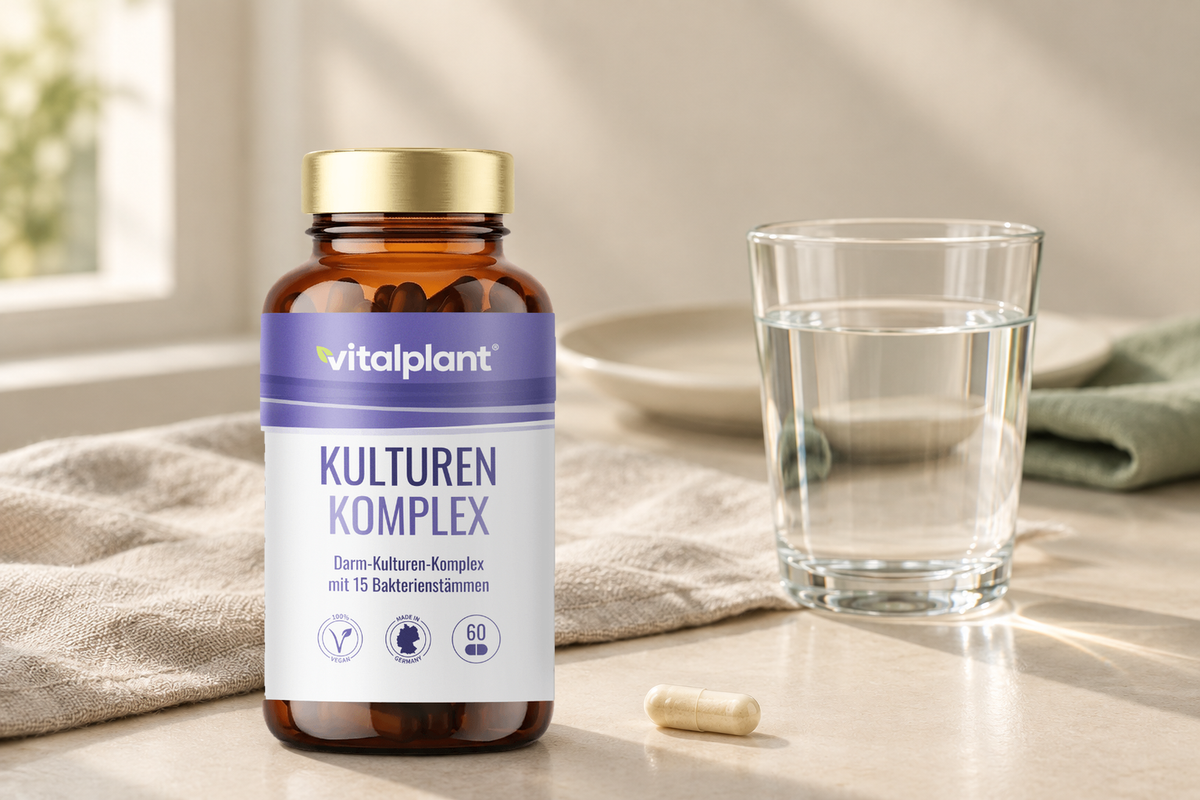
Culture Complex Capsules

Complex Culture Capsules contain 25 billion CFU from 15 live bacterial cultures per daily dose, supplemented with vitamin B2 and biotin. One capsule daily, 60 capsules for 60 days. Laboratory-tested from the Memmingen pharmacy manufactory.

€23,90

€565,01 kg
Tax included.
Shipping calculated at checkout.

In stock - Arrives in 2-3 working days!

Size: 60 capsules

Pay securely with PayPal Klarna Visa Mastercard Apple Pay Google Pay American Express

All payment methods

  • PayPalPayPal
  • KlarnaKlarna
  • Visa Visa
  • Mastercard Mastercard
  • Apple Pay Apple Pay
  • Google Pay Google Pay
  • American Express American Express
  • BizumBizum
  • EPS eps
  • iDEAL WeroIdeal
  • MaestroMaestro
  • Shop Pay Shop Pay
  • Union PayUnionPay

Payment is SSL encrypted via Shopify Checkout.

15 Bacterial Cultures with Vitamin B2 and Biotin

Vitalplant’s Kulturen Komplex capsules combine fifteen different live bacterial cultures with two vitamins. One capsule daily, taken about 30 minutes before a meal.

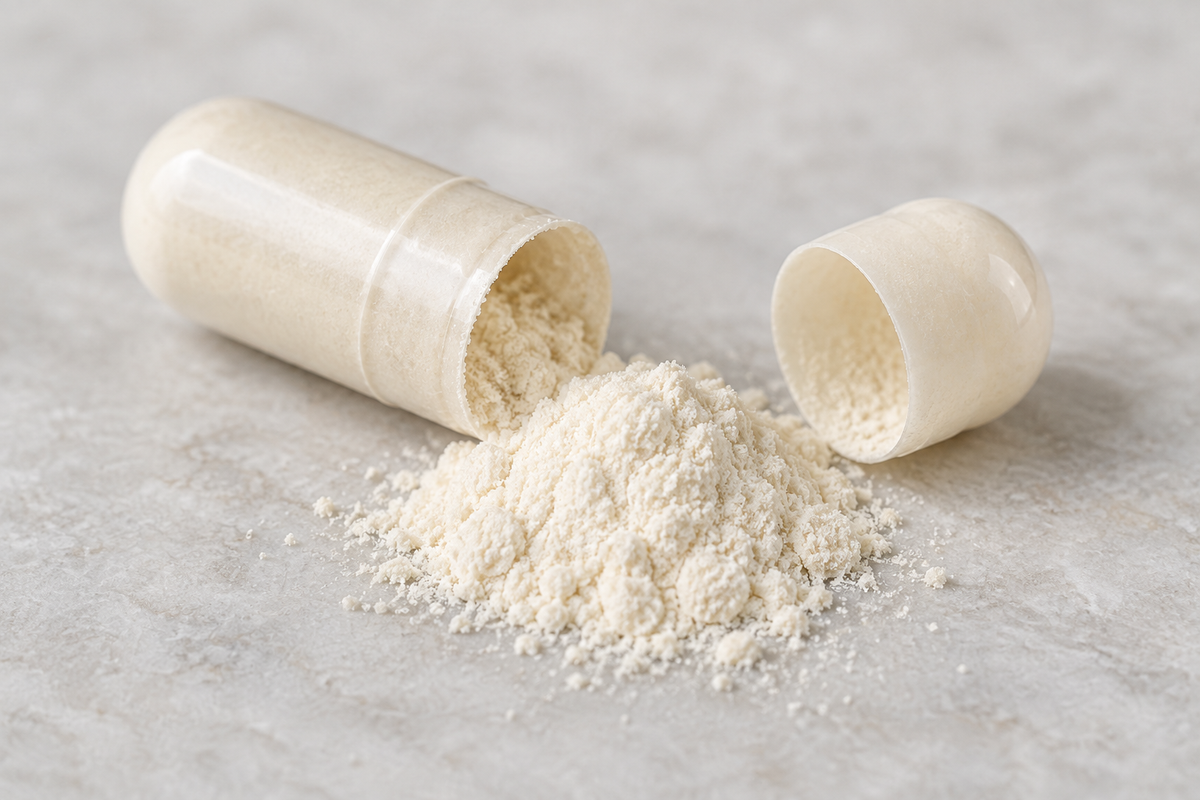
What’s inside the capsule

25 billion CFU per capsule. CFU stands for colony-forming units. The unit does not count bacteria in the literal sense, but the number of germs that can form a visible colony under laboratory conditions. For live cultures, this is the usual measure.

Fifteen strains from three genera. These include five bifidobacteria, eight lactobacilli, and one representative each of Streptococcus thermophilus and Enterococcus faecium. The cultures differ in their growth conditions and acid tolerance.

Vitamin B2 and Biotin. 1.27 mg riboflavin corresponds to 91 percent of the nutrient reference value, 46 micrograms biotin corresponds to 92 percent.

What Vitamin B2 and Biotin do

Riboflavin and biotin both contribute to the maintenance of normal mucous membranes and to normal energy metabolism. Riboflavin also helps reduce tiredness and fatigue and helps protect cells from oxidative stress.

Biotin contributes to normal metabolism of macronutrients and to normal psychological function. All stated claims are listed in the EU Register of nutrition and health claims.

Kulturen Komplex capsules: composition and quality

The formula consists of the culture mix, riboflavin, biotin, and the capsule shell made of hydroxypropyl methylcellulose. No fillers, no anti-caking agents, no colorings. Live cultures are sensitive to heat and moisture, so they are filled in amber glass and cool, dry storage is recommended. Each batch is tested for heavy metals by an independent laboratory.

Behind Vitalplant is Christian Lazar, a licensed pharmacist with over 35 years of professional experience at Stern Apotheke.

Inhalte zuletzt geprüft am

Live bacterial cultures (Bifidobacterium breve, Bifidobacterium bifidum, Bifidobacterium lactis, Bifidobacterium longum,

Bifidobacterium infantis, Lactobacillus acidophilus, Lactobacillus fermentum, Lactobacillus bulgaricus, Lactobacillus casei, Lactobacillus paracasei, Lactobacillus reuteri, Lactobacillus rhamnosus, Lactobacillus plantarum, Streptococcus thermophilus, Enterococcus faecium), Inulin, Fructooligosaccharides, capsule shell: hydroxypropyl methylcellulose, riboflavin, biotin

Recommended use: Take 1 capsule daily, unchewed, with sufficient liquid approx. 30 min before a meal.

Important notes: Food supplements are not a substitute for a balanced and varied diet and lifestyle. The stated recommended daily intake must not be exceeded. Keep out of the reach of small children.

Allergens: According to the raw material specification, it contains no allergens requiring declaration in accordance with Annex II of Regulation (EU) No. 1169/2011.

Storage: Store in a cool, dry place, do not freeze, and protect from direct sunlight.

Gattung, Art und Stamm

Ein vollständiger Bakterienname besteht aus drei Teilen. Auf Gattung und Art folgt die Stammbezeichnung, meist eine Buchstaben-Zahlen-Kombination, unter der der Stamm in einer wissenschaftlichen Sammlung hinterlegt ist.

Dieser dritte Teil ist der entscheidende. Zwei Präparate können dieselbe Art nennen und dennoch völlig verschiedene Stämme enthalten, die sich in Säuretoleranz, Wachstumsverhalten und Untersuchungslage unterscheiden. Wer Produkte vergleicht, sollte deshalb nicht nur auf die Artnamen schauen, sondern darauf, ob die Stämme überhaupt benannt sind.

Die große Umbenennung von 2020

Wer ältere und neuere Etiketten nebeneinanderhält, stolpert über Namen, die es früher nicht gab. Der Grund: 2020 wurde die Gattung Lactobacillus, die über Jahrzehnte alles Mögliche zusammenfasste, anhand genetischer Daten in mehr als zwanzig Gattungen aufgeteilt.

Aus Lactobacillus casei wurde Lacticaseibacillus casei, aus Lactobacillus plantarum Lactiplantibacillus plantarum, aus Lactobacillus reuteri Limosilactobacillus reuteri. Nur wenige Arten, darunter Lactobacillus acidophilus, behielten den alten Namen. Beide Schreibweisen sind bis heute im Umlauf, gemeint ist dasselbe Bakterium.

Wann die KBE-Zahl gilt

Lebende Kulturen nehmen während der Lagerung ab, langsam bei Kühlung, schneller bei Wärme und Feuchtigkeit. Eine Keimzahl ist deshalb nur zusammen mit dem Zeitpunkt aussagekräftig, auf den sie sich bezieht.

Seriös ist die Angabe zum Ende der Mindesthaltbarkeit. Wird stattdessen die Zahl zum Zeitpunkt der Herstellung genannt, steht auf der Packung eine deutlich größere Zahl, von der am Ende der Laufzeit nur ein Bruchteil übrig ist. Steht kein Bezugszeitpunkt dabei, lässt sich mit der Zahl schlicht nicht rechnen.

Warum die Kulturen gefriergetrocknet sind

Bakterien überleben als Pulver nur, wenn ihnen das Wasser entzogen wird, ohne sie dabei zu erhitzen. Bei der Gefriertrocknung wird die Kultur eingefroren und das Eis im Vakuum direkt in Dampf überführt, ohne den flüssigen Zustand zu durchlaufen. Die Zellen bleiben dabei in einer Art Ruhezustand.

Der größte Feind ist danach die Restfeuchte. Schon geringe Mengen Wasser lassen den Stoffwechsel wieder anspringen, und die Keimzahl fällt. Deshalb Braunglas statt Beutel, deshalb kühl und trocken, und deshalb gehört die Dose nicht neben den Wasserkocher.

Our Cultures Complex capsules are manufactured to the highest quality standards and independently tested for heavy metals.

✔
Laboratory test - Download here!
✔ Product specification - Download here!

Cultures Complex – Vitalplant capsules with 15 bacterial strains for gut health

€23,90

€565,01 kg

€23,90

€565,01 kg

Drei Blicke in die Kapsel

  • Kulturen Komplex Kapseln - 15 Stämme je Kapsel

    15 Stämme je Kapsel

  • Kulturen Komplex Kapseln - 25 Milliarden KBE je Kapsel

    25 Milliarden KBE je Kapsel

  • Kulturen Komplex Kapseln - 1 Kapsel vor dem Essen

    1 Kapsel vor dem Essen

Product reviews

Aus eigener Herstellung

  • Christian Lazar, Apotheker bei Vitalplant
    Vom Apotheker entwickelt Christian Lazar stellt jede Rezeptur selbst zusammen.
  • Pulver wird von Hand über die Kapselplatte abgestrichen
    Von Hand abgefüllt Kleine Chargen, jede Platte einzeln abgestrichen.
  • Kapselfüllgerät in der Herstellung
    Mechanisch dosiert Gleiche Menge in jeder einzelnen Kapsel.
  • Ohne künstliche ZusätzeKeine künstlichen Süßstoffe, Aromen oder Farbstoffe.
  • Geprüfte RohstoffeUnabhängig laborgeprüft, Analysenzertifikat auf jeder Seite.
  • Lichtgeschützt verpacktBraunglas oder blickdichter Beutel, je nach Produkt.
  • Kurze ZutatenlisteWas nicht hineingehört, steht auch nicht drin.

Frequently Asked Questions

Take one capsule daily, swallowed whole with plenty of liquid, about 30 minutes before a meal. That's all there is to it. The easiest way is to link taking it to a regular meal, usually breakfast.

Because the stomach is less acidic before a meal than shortly afterward. As soon as a meal arrives, stomach acid production ramps up. Live cultures survive the passage better when they pass through the stomach beforehand. That is why the time gap is explicitly stated in the recommended use.

CFU stands for colony-forming units. The number indicates how many viable bacterial cells are in a capsule, measured by how many of them form a visible colony on a culture medium. Here, 25 billion CFU are distributed across 15 different strains, for a total of 273.66 mg of culture blend per capsule.

Five bifidobacteria: breve, bifidum, lactis, longum and infantis. Eight lactobacilli: acidophilus, fermentum, bulgaricus, casei, paracasei, reuteri, rhamnosus and plantarum. Plus Streptococcus thermophilus and Enterococcus faecium. All 15 strains are declared by name on the label, not just as a collective term.

Not necessarily; the storage recommendation is cool and dry. Heat, moisture, and light are the three factors that harm live cultures, which is why the amber glass and tight seal. You should not freeze the capsules. Anyone storing them for a longer period is better off with a cool cupboard than the kitchen shelf above the stove.

Each capsule contains 1.27 mg of vitamin B2 and 46 µg of biotin, corresponding to 91% and 92% of the nutrient reference values. Both have the same approved claim: riboflavin contributes to the maintenance of normal mucous membranes, and biotin contributes to the maintenance of normal mucous membranes. Riboflavin also contributes to the reduction of tiredness and fatigue.

There is no fixed duration; the product is intended for regular use over a longer period. One can lasts two months. If you are taking medication at the same time, discuss the combination with your doctor or pharmacist beforehand.

The jar contains 60 capsules and, at one capsule per day, lasts 60 days. Besides the cultures, vitamin B2, and biotin, it contains only the capsule shell made of hydroxypropyl methylcellulose. No separating agents, no fillers, no sweeteners.

General ratings from our customers