

Shiitake, botanically known as Lentinula edodes, is the functional mushroom you can also find in supermarkets. It has been cultivated on wood in China and Japan for centuries and is now one of the most widely cultivated edible mushrooms in the world. Its rich, savory flavor has made it a classic in many cuisines.
In this guide, you'll learn where shiitake comes from, what compounds and nutrients it contains, and what research has investigated about its effects. We'll also cover how to prepare it, whether you can eat it raw, what shiitake dermatitis is, and what to look for in capsules and extracts.
At Vitalplant, we make our Organic Shiitake Capsules at our family-run facility in Memmingen: 500 mg of organic extract per capsule, packaged in amber glass and free from fillers. But before we get to capsules, let's take a closer look at the mushroom itself.
Das Wichtigste in Kürze
- Shiitake (Lentinula edodes) is an edible and medicinal mushroom from East Asia, traditionally grown on hardwood logs.
- It contains beta-glucans such as lentinan, as well as eritadenine, ergothioneine and ergosterol, which produces vitamin D2 when exposed to UV light.
- Human studies are few and small; most research comes from laboratory and animal studies.
- Always cook shiitake thoroughly. In rare cases, shiitake dermatitis, a striped skin rash, can occur even after eating cooked mushrooms.
- When choosing capsules, check the species, the amount of extract per capsule and whether it comes from the fruiting body or mycelium.
What is shiitake? A closer look at the shiitake mushroom
Shiitake is a wood-dwelling mushroom native to East Asia. In the wild, it grows on dead hardwood, particularly shii trees, oaks, and related trees. It does not grow wild in Europe. Its cap ranges from light to dark brown, often with fine white scales around the edge, and the gills underneath are creamy white. The stem is tough and fibrous.
The name shiitake mushroom is actually redundant. It comes from Japanese and has a literal meaning: Shii is the name of the tree on which the mushroom is traditionally grown, a tree in the beech family, while take means mushroom. In Chinese, it is called Xianggu, meaning fragrant mushroom. In German, it is also known as Pasania mushroom or Japanese wood mushroom.

💡 Good to know: Botanically, shiitake belongs to the Omphalotaceae family. One of its relatives is the poisonous jack-o'-lantern mushroom, which grows on olive trees in southern Europe and glows faintly in the dark.
Cultivation: on logs or substrate
Shiitake is one of the oldest cultivated mushrooms. Tradition holds that it has been grown in China for around a thousand years. One of the earliest written instructions appears in a Chinese agricultural book by Wang Zhen from 1313: notch logs, add mushroom material, and tap them regularly.
In the traditional method, holes are drilled into hardwood logs, which are inoculated with mushroom spawn and stored in the shade. It often takes one to two years until the first harvest, after which a log produces mushrooms for several years. Today, the vast majority of the world's harvest comes from China and is grown on substrate blocks made from sawdust and grain. This is considerably faster. Log-grown shiitake are considered particularly firm and flavorful, which is why they cost more.
Shiitake compounds and nutritional values
Fresh shiitake is about 90 percent water and low in calories. Its nutrients are highly concentrated when dried. Values from the USDA nutrient database:
Per 100 g |
Fresh |
Dried |
Energy |
34 kcal |
296 kcal |
Protein |
2,2 g |
9,6 g |
Carbohydrates |
6,8 g |
75,4 g |
of which fiber |
2,5 g |
11,5 g |
Fat |
0,5 g |
1,0 g |
Copper |
0,14 mg |
5,2 mg |
Pantothenic acid |
1,5 mg |
21,9 mg |
Vitamin D |
0,4 µg |
3,9 µg |
Lentinan, eritadenine, ergothioneine: the characteristic compounds
- Beta-glucans: long chains of sugars found in the mushroom's cell wall. The best-known beta-glucan in shiitake is called lentinan.
- Eritadenine: a compound found almost exclusively in shiitake and studied primarily in animal experiments.
- Ergothioneine: a sulfur-containing amino acid. Shiitake contains about three to four times as much as the button mushroom.
- Ergosterol: a precursor that is converted into vitamin D2 under UV light.
- Flavor compounds: Lenthionine gives shiitake its characteristic, slightly garlic-like aroma, while glutamate and guanylate provide its savory umami flavor.
The amount of each compound in a mushroom depends heavily on the variety, cultivation, storage, and drying methods.
💡 Good to know: Placing fresh shiitake in the sun with their gills facing up for an hour or two before cooking can increase their vitamin D2 content severalfold. UV light converts the ergosterol in the mushroom, much like the production of vitamin D in our skin.
Shiitake effects: what research has investigated
Shiitake is one of the most thoroughly studied edible mushrooms. Much of the research comes from laboratory and animal studies, often using isolated compounds such as lentinan or eritadenine rather than the whole mushroom. Such results cannot simply be applied to humans.
There are only a few human studies, and they are small. A frequently cited study from 2015 had 52 healthy adults eat 5 or 10 grams of dried, cooked shiitake daily for four weeks and measured various immune system markers. There was no comparison group that did not eat mushrooms, and the study was funded by mushroom industry associations. Other small studies have investigated blood lipids and the gut microbiome. None of this evidence supports definitive conclusions. You can find the individual studies in the sources below.
Shiitake in tradition
In China and Japan, shiitake has been a prized food and a staple of the cuisine for centuries, featuring in broths, braised dishes, and vegetarian temple cooking. This tradition primarily shows the importance of the mushroom in East Asia. It is not scientific evidence of an effect.
How to prepare shiitake
Shiitake is versatile in the kitchen. It has a rich, slightly smoky, savory flavor and works well in stir-fries, ramen, miso soup, risotto, pasta, or as a side for meat and tofu.

- Fresh shiitake: Clean with a brush or paper towel; do not wash. Cut off the tough stems and use them for broth. Fresh shiitake mushrooms keep for a few days in a paper bag in the refrigerator.
- Dried shiitake: For the most flavor, soak overnight in cold water in the refrigerator. For a quicker option, soak in lukewarm water for 20 to 30 minutes. The soaking water is very flavorful and makes a good base for soups and sauces.
- Cooking: Always cook shiitake thoroughly by frying, braising, or simmering it in soup. Do not eat it raw or only briefly heated.
Can you eat shiitake raw?
It's best not to. Raw shiitake contains lectins that are destroyed only by cooking. There is also a particular skin reaction reported mainly after eating raw or undercooked mushrooms: shiitake dermatitis, also known medically as flagellate dermatitis.
One to two days after eating, itchy, streak-like red marks appear on the torso, arms, or legs, resembling whip marks. Sunlight can make them worse. The marks disappear on their own, but this can take up to eight weeks. Lentinan is thought to be the trigger. The German Federal Institute for Risk Assessment (BfR) notes that lentinan is not heat-sensitive, so the reaction can also occur after eating cooked mushrooms. Overall, it is rare. Anyone who has had this reaction should avoid shiitake in the future.
💡 Good to know: Dried shiitake has a more intense flavor than fresh. Drying produces more guanylate, the compound behind its savory umami flavor. In Japan, shiitake dashi is therefore the vegetarian version of the classic broth.
Shiitake capsules: powder, extract, and mycelium
If you want to use shiitake beyond the kitchen, you can find it as a powder, a shiitake extract in capsules, or a tincture. The differences are greater than they may first appear.
Form |
What's inside |
Good to know |
Fresh mushroom |
Whole fruiting body, high water content |
For cooking; always cook thoroughly |
Mushroom powder |
Dried, ground fruiting body |
Not standardized; compounds bound in the cell wall |
Extract |
Compounds usually extracted with hot water |
Concentrated, precise amount per capsule |
Mycelium |
Network of fungal threads, often grown on grain |
May contain a lot of starch from the growing medium |

How to identify good shiitake capsules
- Clearly named species: The label should say Lentinula edodes.
- Extract with stated quantity: How many milligrams of extract are in one capsule and in the daily serving?
- Fruiting body or mycelium: Reputable manufacturers state what the extract is made from.
- Organic and laboratory-tested: Mushrooms absorb heavy metals from their surroundings. Every batch should be tested as standard.
- Short ingredient list: Extract and capsule shell, with no fillers or anti-caking agents.
Shiitake dosage: how much per day?
There is no official recommended daily amount for shiitake. As a food, eat it in normal portions, such as a handful of fresh mushrooms in a pan or a few dried ones in soup. In the 2015 dietary study, participants ate 5 or 10 grams of dried shiitake per day.
For capsules, follow the recommended intake on the packaging and do not exceed it. For our Organic Shiitake Capsules, that means 2 capsules daily containing a total of 1.000 mg extract, taken with a meal and plenty of liquid. There is no proven benefit to taking them at a particular time of day.
Shiitake side effects and safety
When cooked, shiitake is generally considered well tolerated as a food. Still, there are a few things to be aware of:
- Shiitake dermatitis: Rare, mainly after eating raw or undercooked mushrooms. Skin reactions have also been reported after taking shiitake powder.
- Digestive discomfort: Large amounts may cause a feeling of fullness or loose stools. Always chew whole mushrooms thoroughly.
- Mushroom allergy: Anyone allergic to mushrooms should avoid shiitake. Respiratory allergies caused by inhaled spores have been reported among mushroom growers.
- Purines: Like other mushrooms, shiitake contains purines. If you are prone to gout, it is best to discuss eating larger amounts with your doctor.
- Medication, pregnancy, and breastfeeding: If you take immunosuppressants or other medication regularly, are pregnant, or are breastfeeding, consult a healthcare professional before taking extracts. There is insufficient data for these groups.
Vitalplant Organic Shiitake Capsules
Our Organic Shiitake Capsules contain 500 mg of extract powder per capsule from Lentinula edodes grown under certified organic conditions, inspection body number DE-ÖKO-039. At two capsules daily, shiitake is the highest-dose single-mushroom product in our range. The capsule contains nothing but the extract and a vegan shell made from hydroxypropyl methylcellulose. According to the label, the extract is standardized to 30 percent polysaccharides. 90 capsules last for 45 days and are packaged in amber glass.

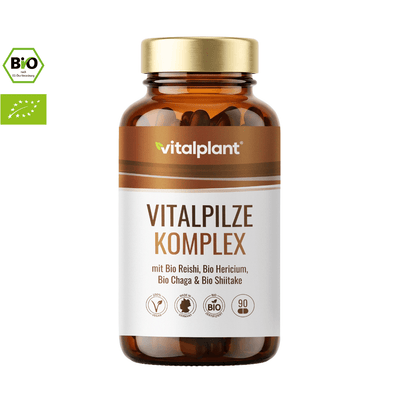
Shiitake is also included in our Organic Functional Mushroom Complex, alongside equal parts Reishi, Hericium, and Chaga.
→ Discover Organic Shiitake Capsules
→ Discover Organic Functional Mushroom Complex