

Collagen Powder
Collagen Powder: Hydrolysate Type I and III from grass-fed cattle
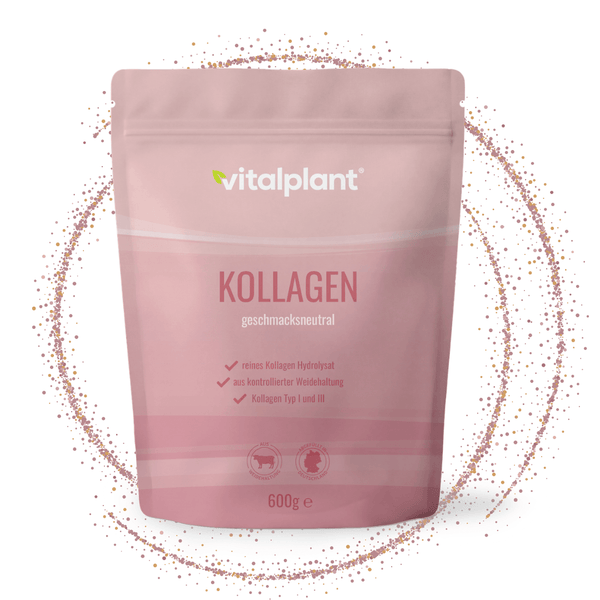
Our classic collagen powder is the foundation of the Vitalplant range: pure collagen hydrolysate of types I and III, sourced from pasture-raised cattle, tasteless and with no additives. 10 g per daily serving, 600 g in the tin — enough for 60 servings. On this page, you’ll learn how animal connective tissue becomes a cold-soluble powder, why the animal species determines the type profile, and how to fit the serving into any daily routine.
Das solltest du über Collagen Powder wissen
Alles über Collagen Powder
Buy collagen powder: pure collagen hydrolysate type I and III
The Vitalplant Collagen Powder is our base product: a collagen hydrolysate from pasture-raised cattle that provides types I and III in their natural ratio. One ingredient, no additives — 10 g per daily serving, 600 g in the tub, so 60 servings for around two months.
If you're looking for an economical, versatile base and don't need a specific branded raw material, this is the right choice. Those who prefer a defined peptide raw material will find it in Move with FORTIGEL or Shine with VERISOL.
From connective tissue to soluble powder: hydrolysis
Native collagen is built as a triple helix — three interwoven protein chains, water-insoluble and not usable in this form. Two steps are needed to turn it into a powder that dissolves in your morning coffee.
Step 1: breakdown
First, the collagen-containing raw material is broken down and purified. In the process, the triple-stranded structure is loosened and the molecular weight drops. The intermediate product of this stage is what you know as gelatin: it dissolves in hot water and gels as it cools.
Step 2: enzymatic hydrolysis
In the second step, enzymes break the chains down further in a targeted way — into short peptides with a molecular weight in the range of a few thousand daltons. This is exactly where the properties are created that make the product suitable for everyday use: it dissolves in cold water, no longer gels, and tastes like nothing. The technical term for this is collagen hydrolysate, synonymous with collagen peptides.
Why the degree of hydrolysis matters
The more evenly the peptide chains are cut, the better the powder dissolves and the less inherent flavor remains. Poorly hydrolyzed products can be recognized by clumping, settling at the bottom of the glass, or a noticeably bitter taste — and are then usually masked with flavorings.
Type I and type III: what's in our powder
Science knows at least 28 collagen types. They differ in structure and where they occur, and the animal species determines which ones you get.
Type I — the workhorse
About 90 percent of the collagen in the human body is type I. It forms the fibers in the dermis, in tendons and ligaments, and it is part of the organic bone matrix. Its fibers are designed for tensile strength.
Type III — the constant companion
Type III occurs in the skin, in blood vessels, and in internal organs, usually together with type I. The two almost always appear as a pair in tissue — so it makes sense to take them together as a dietary supplement as well.
And type II?
Type II is the cartilage type and is obtained from chicken sternum. It is not in our powder, because this one is made from bovine collagen. If you're looking for type II, you need a different raw material.
Beef, fish, or chicken: the animal species makes the difference
On the market, you'll come across three sources. They don't differ in “good or bad,” but in their type profile:
- Bovine collagen provides types I and III — the profile closest to human connective tissue. Our choice.
- Fish collagen (often “marine collagen”) provides mostly type I. It has very small peptides, but also a characteristic odor and is not suitable for people with fish allergies.
- Chicken collagen provides mostly type II from cartilage and is usually used in other product categories.
Pasture-raised: why origin matters
Collagen is an animal raw material — and its quality therefore starts not in the factory, but with the animal. We source our collagen exclusively from pasture-raised cattle. That is a conscious decision in favor of more species-appropriate husbandry and a supply chain that can be traced.
On top of that comes testing: every batch is checked by independent laboratories for heavy metals and microbiological purity before it is filled in our manufactory in Memmingen. The analysis certificate can be viewed on the product page — not on request, but openly.
The product at a glance
VITALPLANT COLLAGEN POWDER — type I and III, 10 g per serving
- Collagen hydrolysate type I and III from pasture-raised cattle
- 10 g per daily serving — 600 g tub for 60 servings
- Neutral in taste, dissolves in cold and warm liquids
- A single ingredient: no flavoring, no sweetener, no filler
- Lab-tested for each batch, filled in Memmingen
→ Discover collagen powder now
How to fit the serving into everyday life
Ten grams sounds like a lot, but disappears into almost any drink. A few tried-and-tested ways:
In coffee or tea
The easiest way, because it fits into an existing habit. Peptides are heat-stable, so you can stir them directly into a hot cup.
In a smoothie or juice
Especially practical in combination with vitamin C-rich ingredients — orange, acerola, blackcurrant. Vitamin C contributes to normal collagen formation for normal skin function.
In porridge, yogurt, or quark
Simply stir in. The consistency does not change because hydrolysate does not gel.
In soup, sauce, or batter
That works too — for anyone who prefers to include the serving in a meal rather than a drink.
Collagen is not protein powder
A misconception we often hear: collagen is a protein, so it is protein powder. The first part is right, the second is not.
Collagen has a very characteristic amino acid profile: about every third amino acid is glycine, plus plenty of proline and hydroxyproline. What is practically missing is tryptophan — an essential amino acid. That means collagen is not a complete protein and is unsuitable as a basis for muscle building.
If you're looking for a complete protein source, you'll find it in our Bio Vegan Protein made from pea, rice, and pumpkin seed. Collagen is something different: a targeted supplement with its own unusual amino acid profile.
What else belongs in the tub — and what doesn't
Our tub contains exactly one ingredient. No flavoring, no sweetener, no coloring, no anti-caking agent. That's not a cost-cutting measure, but a statement of quality: good collagen hydrolysate is naturally flavorless and free-flowing — it doesn't need anything to cover up the taste or improve flow.
If you come across a collagen powder with a long ingredient list when comparing products, it's worth taking a second look: how much pure collagen is actually in the serving at the end? Always calculate based on the daily serving, not per 100 g.
Collagen and vitamin C
The only authorized health claim related to this topic is not about collagen, but about vitamin C: Vitamin C contributes to normal collagen formation for normal function of the skin, bones, cartilage, gums, and blood vessels. The background is biochemical: vitamin C is needed as a cofactor in the body's own collagen synthesis.
That's why many people combine their collagen routine with Vitamin C 1000 or the natural Acerola Capsules. You can find both in our vitamins category.
Conclusion: the uncomplicated base
Collagen Powder is our entry-level product and at the same time the most economical: 60 servings of 10 g each, one ingredient, transparent origin, lab-tested. If you're trying collagen for the first time or looking for a base you can dose freely, start here.
More on the topic: the overview in the collagen category with all the basics and the legal classification, Collagen Move for active routines and Collagen Shine for the beauty routine.
Note: Dietary supplements are not a substitute for a varied and balanced diet and a healthy lifestyle. The recommended daily intake stated should not be exceeded. Keep out of reach of small children.
