

Magnesium
Buy magnesium: citrate, bisglycinate, or 3-in-1 complex
Magnesium is the most searched-for mineral of all — and the one where the most goes wrong. Because between “400 mg magnesium” on one package and “400 mg magnesium oxide” on another, there is a difference that hardly anyone explains. At Vitalplant, you’ll find three magnesium products in organically bound compounds: citrate, bisglycinate, and a 3-in-1 complex of citrate, bisglycinate, and malate. On this page, you’ll learn how they differ, how to compare the elemental amount correctly, and why splitting the daily dose often does more than a higher number.
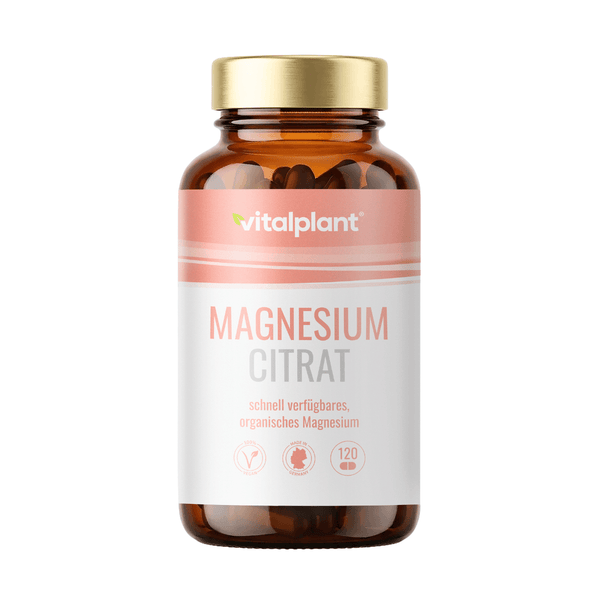
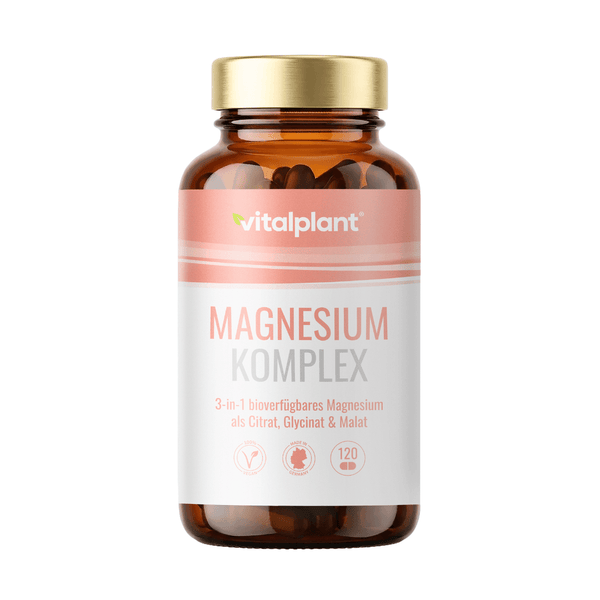
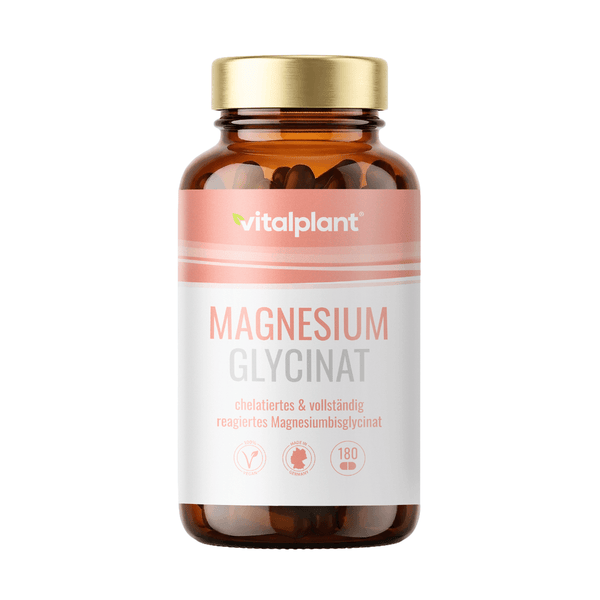
Three magnesium compounds with 100 percent of the nutrient referenc...
Das solltest du über Magnesium wissen
Alles über Magnesium
Buy magnesium: which form is right for you?
Magnesium is the most frequently purchased mineral in Germany — and the one where comparing labels most often leads you astray. On this page, we clear that up: which forms there are, how to read the elemental amount correctly, how to dose sensibly, and which of our three products fits your routine.
All three are vegan, lab-tested, and free from magnesium stearate and fillers. Part of our Minerals category.
Why magnesium is searched for so often
As a cofactor, magnesium is involved in over 300 enzymatic reactions — from muscle contraction and nerve impulse transmission to energy production in cells. In the body, the universal energy carrier ATP is practically always present as a magnesium complex. Without magnesium, metabolism slows down.
The approved claims
Few nutrients have such a long list. Magnesium contributes to:
- the reduction of tiredness and fatigue
- a normal energy-yielding metabolism
- normal muscle function
- normal functioning of the nervous system
- normal psychological function
- electrolyte balance
- normal protein synthesis
- the maintenance of normal bones and teeth
- and it has a role in cell division
The forms in detail
Magnesium never appears in capsule form on its own — it is always bound to a partner. This bond determines absorption, tolerability, and price.
Magnesium citrate
Magnesium bound to citric acid. Well water-soluble, highly bioavailable, stomach-friendly — the proven all-rounder. Our Magnesium Citrate provides 246 mg of elemental magnesium per daily dose (2 capsules).
Magnesium bisglycinate
Magnesium bound to two molecules of the amino acid glycine. This form is considered the gentlest: it is absorbed via the amino acid transport pathway and is therefore particularly well tolerated — even by sensitive stomachs. Our Magnesium Glycinate provides 280 mg of elemental magnesium per daily dose (4 capsules).
Magnesium malate
Magnesium bound to malic acid. Also organically bound and highly available; a component of our complex.
Magnesium oxide — and why we don't use it
Magnesium oxide is the cheapest option and contains a lot of magnesium per gram. That makes it attractive on the label. The catch: it is absorbed much less effectively than organically bound forms and tends to have a more laxative effect in larger amounts. If you're looking for a high number on the tin, you'll find it with oxide — but not if you're looking for reliable supply.
The calculation that makes the difference
The most common comparison mistake: confusing the amount of the compound with the amount of the mineral. 800 mg of magnesium citrate is not 800 mg of magnesium, but about 123 mg of elemental magnesium — the rest is citrate. Always look for the label "elemental magnesium" or the NRV percentage value; anything else is not comparable.
Our three magnesium products
VITALPLANT MAGNESIUM CITRATE — 246 mg elemental per daily dose
- Magnesium citrate, organically bound and highly soluble
- 246 mg of elemental magnesium per daily dose (2 capsules)
- Magnesium contributes to normal muscle function
- Magnesium contributes to the reduction of tiredness and fatigue
- Vegan, without magnesium stearate, lab-tested
→ Discover Magnesium Citrate now
VITALPLANT MAGNESIUM GLYCINATE — the gentle form
- Magnesium bisglycinate, bound to the amino acid glycine
- 280 mg of elemental magnesium per daily dose (4 capsules)
- Particularly well tolerated — even with a sensitive stomach
- Magnesium contributes to normal psychological function
- Vegan, without additives, lab-tested
→ Discover Magnesium Glycinate now
VITALPLANT MAGNESIUM COMPLEX 3-IN-1 — 375 mg, 100% NRV
- Three forms: citrate, bisglycinate, and malate
- 375 mg of elemental magnesium per daily dose (3 capsules)
- Equals 100 percent of the EU reference intake
- Magnesium contributes to a normal energy-yielding metabolism
- Vegan, without magnesium stearate, lab-tested
→ Discover Magnesium Complex now
Which one is right for you?
- You're looking for straightforward everyday supply → Magnesium Citrate. Proven, stomach-friendly, two capsules a day.
- You have a sensitive stomach or prefer to take magnesium in the evening → Magnesium Glycinate. The gentlest form.
- You want to cover the reference intake completely or combine several forms → Magnesium Complex 3-in-1 with 375 mg.
How much magnesium per day?
The German Nutrition Society recommends 300 to 400 mg daily for adults; the EU reference intake (NRV) is 375 mg. Important: that is the total amount including diet, not the amount that needs to be supplemented.
A higher need typically exists during intense sport (loss through sweat), in demanding life phases, during pregnancy and breastfeeding, and with an unbalanced diet.
Taking it: timing, splitting, and tolerability
The timing
Free to choose; many prefer the evening. No specific time of day is proven — consistency matters most.
The split
This is the practical lever that hardly anyone uses: the body cannot absorb magnesium arbitrarily fast. The larger the single dose, the smaller the share that actually gets through. Two smaller portions spread across the day are therefore more effective than one large one — and also prevent the well-known side effect.
If stool becomes loose
This is the typical sign of too high a single dose, harmless and easy to fix: reduce the amount, split it up, or switch to the gentler bisglycinate form.
When medical advice is needed
With impaired kidney function, any magnesium supplement should be discussed with a doctor, because excess magnesium is excreted through the kidneys.
Magnesium in foods
The best natural sources are plant-based: pumpkin seeds and sunflower seeds, almonds and cashews, wholegrain products, legumes, green leafy vegetables, and dark chocolate. Magnesium-rich mineral water also helps — it's worth checking the analysis on the label.
One note on preparation: magnesium is water-soluble and partly leaches into the water during cooking. Steaming instead of boiling, or using the cooking water, helps retain more of it.
Useful combinations
Magnesium works together with other nutrients in the body:
- Vitamin D contributes to normal calcium absorption and utilisation; our Vitamin D3+ capsules already contain magnesium.
- B vitamins contribute, like magnesium, to a normal energy-yielding metabolism → Vitamin B Complex Forte
- Calcium and zinc compete for absorption pathways — so spacing them apart is worthwhile.
Quality from the workshop in Memmingen
All three products are filled in our family-run workshop in the Allgäu. We use exclusively organically bound forms, do not use magnesium stearate, anti-caking agents, or fillers, and have every batch independently tested. Filling is done in light-protective pharmacy-grade brown glass.
Conclusion
With magnesium, three things matter: the right form, the elemental amount — and splitting the daily dose. If you pay attention to that, you get more out of a moderate dose than from a high number in a poor form.
Discover more: all minerals and trace elements at a glance, the matching vitamins for synergy, and the Energy & Sports topic world.
Note: Food supplements are not a substitute for a varied and balanced diet and a healthy lifestyle. Do not exceed the stated recommended daily intake. Keep out of the reach of small children. Information according to Regulation (EC) No. 1924/2006 and Regulation (EU) No. 432/2012.
