


In the ingredient lists of good men’s formulas, it is almost always near the top, and yet most people can’t do much with it: L-citrulline. The name sounds like a lab term, but it comes from the garden — and the amino acid is one of those building blocks where the chemical form determines how it is used.
This text explains what L-citrulline is, what role it plays in the body, why it often appears alongside L-arginine in formulas, and how to tell the two common forms apart — the distinction that makes products genuinely comparable.
The name comes from watermelon
In 1914, the Japanese researchers Koga and Odake isolated a previously unknown amino acid — from watermelon juice. Its botanical name is Citrullus lanatus, and that is where the substance got its name: citrulline.
That is more than just an anecdote. Watermelon is still the best-known natural source. However, the content varies considerably — depending on the variety, ripeness, and above all the part of the fruit:
| Part of the fruit | Approximate citrulline content |
|---|---|
| Red flesh | about 0.7 to 3.5 g per kilogram |
| White layer directly under the rind | significantly more than the flesh |
| Yellow-fleshed varieties | usually higher than red-fleshed ones |
If you convert that, the difference between food and supplement becomes clear: For the 2 grams contained in a daily dose of a typical formula, you would need roughly half a kilogram to nearly three kilograms of flesh depending on the variety — and every day at that. Possible in August, difficult in February.
There are also two smaller sources: cucurbits in general contain citrulline in smaller amounts, and the body itself produces it — mainly in the liver and intestines.

What L-citrulline does in the body
L-citrulline belongs to the non-proteinogenic amino acids. That means: unlike leucine or lysine, for example, it is not built into proteins. It is not a building block, but an intermediate step.
Its natural place is the urea cycle — the metabolic pathway through which the body removes ammonia produced when protein is broken down. Ammonia is cell-damaging in higher amounts, so it is converted in several steps into urea and excreted via the kidneys. L-citrulline is one of the stops along this path.
The same cycle also provides the second reason why L-citrulline is interesting in formulas: The body can use it to form L-arginine. This happens mainly in the kidneys, in two enzymatic steps. L-arginine in turn is the starting substance from which the body produces nitric oxide — a signaling molecule that plays a role in many tissues.
Nitric oxide was long a blind spot in physiology — it was not until 1998 that the Nobel Prize in Medicine went to the researchers who explained its role as a signaling molecule.
Why citrulline and not arginine directly?
The question is an obvious one: If the body needs arginine, why not just take arginine?
The reason lies in the digestive route. Orally taken L-arginine first passes through the intestinal wall and then the liver, and in both places a significant portion is broken down by the enzyme arginase before it even reaches the bloodstream. Experts call this the first-pass effect.
L-citrulline largely bypasses this breakdown: it is not attacked by arginase, passes through the intestines and liver, and is only then converted into arginine in the kidneys. In studies measuring blood levels, a given amount of L-citrulline therefore leads to a higher and longer-lasting arginine level than the same amount of arginine itself.
That is exactly why well-designed formulas place both side by side: arginine for the quick route, citrulline for the sustained one. Anyone who only reads the name of an ingredient won’t see that — anyone who knows its role will.
The two forms: base and malate
In stores, L-citrulline is available in two variants, and the labels do not always make the difference clear.
| Form | What it contains | Where it is commonly used |
|---|---|---|
| L-citrulline base | pure L-citrulline, without a carrier acid — 1,000 mg base equals 1,000 mg citrulline | Capsule formulas, when it is all about the amino acid itself |
| L-citrulline malate | L-citrulline bound to malic acid (malate). Depending on the ratio (usually 2:1), about 55 to 60 percent of the weight is citrulline, the rest is malate | Sports powders — malate is also an intermediate in the citric acid cycle |
- The calculation trap: „6,000 mg L-citrulline malate“ is not 6,000 mg citrulline, but rather around 3,300 to 3,600 mg. Anyone comparing two products must read the form as well — otherwise they are comparing apples and oranges, literally.
- Reputable labels state both: the amount of the compound and the pure citrulline content. If only the compound amount is listed, the product cannot be properly classified.
- Both forms are equivalent, as far as the citrulline itself is concerned. The choice depends on the application, not the quality.

What amounts are used in research
Research on L-citrulline mainly works in a range of 3 to 6 grams daily for the base, and correspondingly higher amounts for malate, because only part of the weight is citrulline there. In formulas that combine the amino acid with arginine, the individual amounts are often lower, because both pathways are used together.
For practical use, another number matters: the recommended daily intake on the package. It is matched to the respective formula and should not be exceeded.
What else is in a men’s formula
L-citrulline rarely stands alone. What is beside it often says more about the formula than the main ingredient — especially because some of these substances have a well-established role in the body:
- Zinc contributes to maintaining normal testosterone levels in the blood, normal fertility and reproduction, and protecting cells from oxidative stress.
- Selenium contributes to normal sperm production and also to protecting cells from oxidative stress.
- Creatine improves physical performance during short-term, high-intensity exercise in explosive strength training — from a daily intake of 3 grams.
- Pine bark extract comes from French maritime pine and is rich in oligomeric proanthocyanidins, a group of polyphenols. It is standardized to this content.
Zinc and selenium are the two ingredients for which the contribution can be named. Anyone comparing a formula should therefore check whether they are included in a meaningful amount — and not just as a trace on the label.
How to read a formula
Five points you can check on the label — with every provider:
- Form and pure content. Base or malate, and how much citrulline is actually in it?
- Daily dose instead of capsule count. 500 mg per capsule means nothing unless you know how many capsules make up the daily serving.
- Is arginine listed as well? The combination has a biochemical reason, as described above — it is not a marketing add-on.
- What else is in the formula? Zinc and selenium are the two ingredients for which a contribution to the body can be named — in a meaningful amount, not just as a trace.
- Anti-caking agents and fillers. A short ingredient list is a good sign; capsule shells made from plant cellulose are standard.

Where L-citrulline is included in our products
| Product | Form and amount | What else is in it |
|---|---|---|
| Men’s capsules | L-citrulline base, 500 mg per capsule — at the daily dose of 4 capsules, that is 2,000 mg | 1,600 mg L-arginine base, 200 mg pine bark extract, plus zinc and selenium |
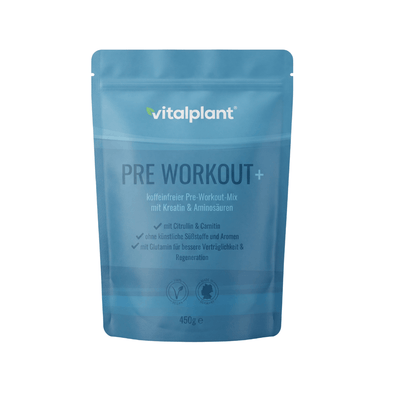
| Pre Workout+ powder | L-citrulline malate, 5 g per serving | 4 g creatine monohydrate, 4 g L-glutamine, 1.5 g taurine, 0.5 g acetyl-L-carnitine — caffeine-free |
The two products follow different approaches: The Men’s capsules rely on the combination of both amino acids in base form, the Pre Workout+ on the malate compound in a sports context. Both are laboratory-tested and come from the manufacturing facility in Memmingen. You can find more amino acids and micronutrients in our categories Vitamins and Minerals.
Safety and who should be cautious
- L-citrulline is generally considered well tolerated in usual amounts. Occasional complaints affect the gastrointestinal tract and are more likely to occur at high single doses.
- Anyone taking blood pressure-lowering medication or products from the PDE-5 inhibitor group should seek medical advice before taking it — both act on the same regulatory pathway.
- With kidney disease, any supplement with amino acids should be discussed with a doctor, because the kidneys are involved in their conversion.
- Pregnant and breastfeeding women as well as people on long-term medication should consult a doctor before taking it.
In summary
- L-citrulline is a non-proteinogenic amino acid named after watermelon (Citrullus lanatus), from which it was first isolated in 1914.
- It belongs to the urea cycle and can be converted in the body — mainly in the kidneys — into L-arginine.
- Unlike arginine, it largely escapes breakdown by the enzyme arginase during digestion; that is why formulas often contain both side by side.
- Base and malate differ in pure content: in malate, only about 55 to 60 percent of the weight is citrulline.
- In men’s formulas, it usually appears alongside zinc and selenium — the two trace elements for which a contribution to the body can be named.
Food supplements are not a substitute for a varied diet and a healthy lifestyle. Do not exceed the stated recommended daily intake.