

OPC from grape seed extract is one of the most popular plant compounds on the supplement shelf. And few questions I hear at the pharmacy counter are more common than questions about the effects of OPC. What is really behind the oligomeric proanthocyanidins found in grapes? This guide gives you an honest, well-founded answer: from the definition, traditional use and research to dosage, quality, the role of vitamin C and potential side effects.
My name is Robert Lazar. I grew up among the wooden drawers of Stern Apotheke, my father's family-run pharmacy. Today, I develop food supplements at Vitalplant in Memmingen. Here, you'll find facts about their origins, ingredients and the research behind them.
Would you like to take it in capsule form? Our OPC grape seed extract capsules provide 440 mg of grape seed extract per capsule, standardised to 70 percent, or 308 mg of pure OPC. They also contain a little black pepper extract to aid absorption. We make them in our family-run manufacturing facility and have them laboratory tested. Read on and I'll explain what's behind it.
Das Wichtigste in Kürze
- OPC stands for oligomeric proanthocyanidins, secondary plant compounds from the group of polyphenols.
- The highest concentration is found in grape seeds, hence the name grape seed extract.
- No health claims are approved for the plant compound itself. Antioxidant claims are only permitted for nutrients such as vitamin C and vitamin E, for example in protecting against free radicals.
- If you are taking blood-thinning medication, or during pregnancy and breastfeeding, consult a doctor beforehand.
What is OPC? Oligomeric proanthocyanidins from grape seeds
OPC stands for oligomeric proanthocyanidins. These are secondary plant compounds belonging to the polyphenol group. They occur naturally in many plants, but are particularly concentrated in grape seeds. Plants produce them as a form of protection against environmental factors.
Grape flesh contains very little of it. The real treasure lies in the seeds. That's precisely why it is extracted from grape seeds. Alongside OPC, the extract contains other plant compounds.
Secondary plant compounds are substances that a plant does not need purely to survive, but uses for protection, colour and defence. OPC belongs to this large group. Polyphenols such as OPC are also found in berries, apples and green tea, for example. As a plant compound, it is nothing exotic, but part of a healthy diet.
By far the best-known source is grape seeds. But OPC is also found in aronia, pine bark and peanut skins. OPC is particularly concentrated there. OPC is extracted from grape seeds. If you only want to obtain it through your diet, however, the amounts in food are small.

OPC effects: research and the law
Now for the big question: what about its effects? I'll explain what researchers are investigating and where the law sets clear limits.
Free radicals, antioxidants and oxidative stress explained simply
First, a few basics to put this in context. Free radicals are constantly produced in your body, for example through metabolism, UV radiation or smoking. When free radicals predominate, this is known as oxidative stress. Antioxidants are substances that can neutralise free radicals.
Damage caused by free radicals is associated with cellular ageing, among other things. This is where nutrients come in for which there are reliable and, above all, authorised claims.
Protecting cells from oxidative stress: the role of vitamins C and E
This is the part that is clear from a legal standpoint, and it matters. As antioxidants, vitamins C and E help protect cells from oxidative stress.
Vitamin C also supports normal collagen formation for the normal function of skin. If this matters to you, look for a combination with this nutrient. Our product itself does not contain vitamin C, so I want to make that clear.
What research is investigating about OPC
And what about the extract itself? Its antioxidant properties are indeed being researched. Among other things, researchers are investigating a potential antioxidant effect. Studies often describe OPC as a powerful antioxidant that can neutralise free radicals. It's important to put this in context: many of these studies are small and were conducted in laboratories or on animals.
A potential anti-inflammatory effect is also being discussed in research. However, this does not prove that OPC is effective in humans. These studies do not provide grounds for an authorised health claim for such a product. The fact that OPC has been the subject of research for years does not change that.
How does OPC work in the body?
Whether OPC has an effect and how it is absorbed in the body depend heavily on its form. It is water-soluble, but its bioavailability is considered limited. That's why some manufacturers, including us, combine it with black pepper extract, which may improve absorption.

Taking OPC: capsules, dosage and combinations
Let's get practical. Capsules are the easiest option because they provide a precise dose. Many people take it in the morning on an empty stomach, leaving some time between taking it and eating protein-rich meals such as cheese or eggs.
How to take OPC capsules
There is one simple rule for OPC capsules: follow the recommended intake on the pack. For our capsules, that's two per day, which can be split into two doses. Take the capsule with plenty of liquid.
How much OPC per day? Amounts and mg
There is no fixed guideline. In practice, 1 to 2 mg of OPC per kilogram of body weight is often cited. For someone weighing 70 kilograms, that would be around 70 to 140 mg per day. For a course taken over a limited period, some sources also suggest higher amounts of up to about 400 mg per day.
Our capsules provide 308 mg of OPC per capsule. Two capsules therefore easily cover even higher amounts. Still, don't overdo it. More is not automatically better.
Combining OPC with vitamin C
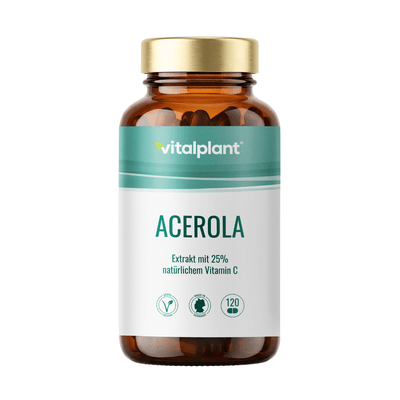
A common suggestion is to combine it with vitamin C. The reason is simple: unlike the plant compound, this nutrient has authorised claims relating to cell protection and collagen. Antioxidants such as vitamin C can therefore be advertised using these claims in compliance with the law. Grape seed extract products with vitamin C are also available. You can find this nutrient in our selection of vitamins and minerals.
Buying OPC: how to recognise good quality
Now I'm in my element, because the differences in quality are enormous. When I buy a batch for us, I always look at the same criteria. I'm happy to share them with you as a checklist.
- OPC content: Look for the stated OPC content, not just the mg of grape seed extract. Standardised extracts clearly state both.
- Polyphenol content: A high total polyphenol content is a sign of a high-quality product.
- Laboratory testing: Content and purity should be independently tested, ideally using the HPLC method.
- Purity: The shorter the ingredient list, the better. Nobody needs unnecessary fillers and additives.
- Packaging: Light protection in amber pharmacy glass helps preserve the sensitive ingredients.
One point that is often overlooked: legally, OPC is a food, more specifically a food supplement. Health claims for such products are strictly regulated. Advertising claims that they protect against one disease or another are simply not permitted. Anyone making such promises is on very thin legal ice.

Side effects, interactions and safety
OPC is generally well tolerated. Even so, there are a few things you should know, especially when taking higher amounts in supplement form.
Is OPC well tolerated?
Side effects are rare at typical doses. Mild gastrointestinal discomfort is occasionally reported, particularly on an empty stomach. If this happens to you, simply take it with a small meal.
Interactions: caution with blood-thinning medication
Interactions are a particularly important consideration. OPC could theoretically enhance the effect of blood-thinning medication. If you take blood thinners, are due to have surgery or have a medical condition, check with your doctor beforehand.
Who should avoid OPC
People who are pregnant or breastfeeding should avoid high-dose OPC supplements because there is insufficient evidence. These supplements are also not intended for young children. When in doubt, it's always better to check with a doctor.
OPC grape seed extract from Vitalplant
Finally, a quick word about our product, without the marketing hype. Our grape seed extract provides 440 mg of extract with 70 percent OPC per capsule, plus 5 mg of black pepper extract to aid absorption. Every batch is independently laboratory tested, and the capsules are vegan and free from unnecessary additives.
Many people who want to benefit from OPC combine it with a vitamin C supplement. This makes sense because the authorised cell-protection claim applies to vitamin C, not the extract. That way, you can combine both honestly, without making unauthorised claims.
→ Discover OPC grape seed extract capsules
→ Discover vitamins & minerals