

Few mushrooms carry as much history as Reishi. In China, it has been known as Lingzhi for around two thousand years, and it appears as a motif in painting, textiles, and architecture. As an edible mushroom, however, it is entirely unsuitable: its flesh is corky and woody, and exceptionally bitter.
In this guide, you'll learn what's behind the Shiny Ganoderma: where it comes from, which compounds it contains, what research actually investigates, and how to recognize a good Reishi supplement.
What is Reishi? A closer look at the Shiny Ganoderma
Ganoderma lucidum is the botanical name of the mushroom most commonly called Reishi in the West. The Latin word lucidus means "shiny" and describes its surface: the cap looks lacquered, is kidney-shaped, and ranges from reddish brown to almost black. This is also where the German name Shiny Ganoderma.
comes from. Reishi grows on deciduous tree stumps, preferably oak in Europe. The name Reishi comes from Japanese; in China, the mushroom is called Lingzhi. Since it can neither be chewed nor fried, it has traditionally been boiled or extracted in East Asia.

Two thousand years of tradition: Reishi throughout history
Lingzhi is described in the Shen Nong Ben Cao Jing, one of the oldest Chinese herbal books, dating back to the Han dynasty. The mushroom also features in Li Shizhen's Ben Cao Gang Mu (1590). In traditional accounts, it was regarded as a symbol of well-being and long life—the name Lingzhi is often translated as "mushroom of spiritual power."
Wild Reishi was rare and long reserved for the nobility. It has only been cultivated on a larger scale since the 1970s. This long tradition is culturally fascinating, but it is not scientific evidence of an effect.
Cultivation and processing: from fruiting body to extract
Different Ganoderma species need different conditions, and different varieties are preferred depending on the region: black Reishi is common in southern China, while red Reishi is preferred in Japan. Today, most of it comes from controlled cultivation.
Because the mushroom is so hard and bitter, it is not eaten raw. The simplest form is ground fruiting body. More common are extracts, which are made by dissolving the mushroom's compounds in hot water or alcohol and then drying them. As a buyer, one thing matters most in the end: how much extract is actually in each capsule?

The compounds: what's in Reishi
Like most mushrooms, fresh Reishi consists largely of water. The dry matter contains three main groups of compounds that are of particular interest to researchers:
Polysaccharides and beta-glucans
Mushrooms produce a wide variety of polysaccharides. Some of these, including beta-glucans, are not broken down in the small intestine. Like other dietary fibers, they pass into the large intestine, where gut bacteria use them.
Triterpenes
Triterpenes are responsible for Reishi's bitter taste. Reishi contains a particularly wide variety of them, including so-called ganoderic acids, which are found in this form only in Ganoderma species.
Phenols, minerals, and proteins
It also contains phenolic compounds, minerals such as potassium, calcium, and magnesium, and proteins. Dried fruiting bodies contain around seven to eight percent protein.
What research investigates
Reishi is one of the most frequently studied medicinal mushrooms. However, much of the research comes from laboratory or animal studies, while human studies are generally small and vary in quality. Such findings cannot establish an effect in humans and are no substitute for medical treatment.
How to recognize a good Reishi supplement
- Extract rather than powder: Check whether the product contains fruiting body powder or extract, and how many milligrams of extract each capsule provides.
- Clear origin: Organic certification with a control body number shows where the raw material comes from.
- No unnecessary additives: Ideally, the ingredients list contains only the extract and the capsule shell.
- Laboratory testing: Reputable manufacturers have their batches tested for contaminants such as heavy metals.
Use and safety
Follow the recommended intake on the packaging and take the capsules with plenty of liquid. Reishi is generally considered well tolerated, though gastrointestinal complaints have occasionally been reported.
You should check with a doctor before taking it if you are using blood-thinning medication, have surgery coming up, are pregnant, or are breastfeeding. Reishi is not intended for children.
Reishi from Vitalplant
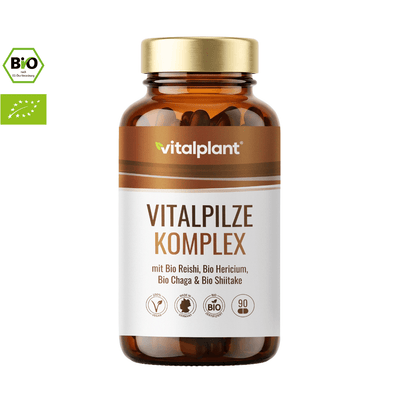
Our Organic Reishi Capsules contain 300 mg of Ganoderma lucidum extract per capsule, from certified organic cultivation (DE-ÖKO-039). The capsule contains nothing but the extract and a vegan shell, and comes in an amber glass bottle. If you'd like to combine several medicinal mushrooms, the Organic Medicinal Mushroom Complex contains equal parts Reishi, Hericium, Chaga, and Shiitake.
→ Explore Organic Reishi Capsules