

There comes a moment when many people think about it for the first time. You get up, and it takes a second longer than it used to. You reach up to the shelf and notice your shoulder getting a say. Nothing dramatic — but it wasn't there before.
The good news: mobility is not a countdown that runs from your date of birth. It depends on things you can influence. The less good news: the course is set earlier than most people think — and the most effective levers are unremarkable.
This text explains what mobility actually consists of, what changes over the years and what is habit rather than age — and which nutrients play a role.
Das Wichtigste in Kürze
- Mobility consists of three systems: joints, muscles, and balance. The third is almost always overlooked.
- Cartilage has no blood vessels — it is supplied through alternating loading and unloading. Rest is therefore rarely the right answer.
- Vitamin C is the only nutrient with an approved claim for cartilage, through collagen formation.
- Frankincense, MSM, glucosamine, and collagen have no approved health claim in the EU.
Mobility is not one system, but three
When people say "mobile," they usually mean the joints. In fact, three systems work together, and each can become a bottleneck on its own:
| System | What it contributes | What happens when it declines |
|---|---|---|
| Joints and cartilage | The gliding surfaces on which movement actually takes place | Movement becomes more cumbersome, the range of motion shrinks |
| Muscles and tendons | Strength to move the body and guide the joints | Getting up, climbing stairs, and carrying things take noticeably more effort |
| Nerves and balance | Coordination, reaction speed, steady steps | Uncertainty on uneven ground, caution instead of confidence |
The third system is almost always overlooked — yet it decides whether someone trusts themselves enough to walk the forest path in the dark. And trust is the beginning of everything that follows: those who trust themselves less move less, and those who move less lose faster.
Cartilage has no blood vessels — that's why movement is so central
This is the point where biology makes an unusually clear statement. Joint cartilage is one of the few tissues in the body without its own blood supply. It doesn't get its nutrients through the blood, but through the synovial fluid — and through a simple mechanical principle:
When under load, the cartilage is compressed and releases fluid. When the load is removed, it soaks back up and absorbs nutrients in the process. Like a sponge. Without this cycle of loading and unloading, cartilage simply lacks a transport route.
This leads to something that goes against most people's intuition: Rest is rarely the right answer for joints. Regular, moderate movement is the way cartilage is supplied at all. The problem is not load, but overload on the one hand and too little movement on the other.

What really changes over the years — and what is habit
Some aspects of aging are biology, some are simply the result of how you've spent the last twenty years. The distinction is worthwhile, because only the second is in your own hands.
| What | Age or habit? | What results from it |
|---|---|---|
| Muscle mass | both — from around age 30 the body slowly breaks it down without training, and faster from 60 | The loss can be slowed and partly reversed with strength training — at any age |
| Joint mobility | mostly habit: the range of motion you don't use is lost first | Anyone who brings the shoulder overhead every day keeps the range longer than someone who doesn't |
| Balance | both — nerve conduction speed decreases, but training has a strong effect | Standing on one leg while brushing your teeth is not a joke, but the easiest training you can build in |
| Recovery time | Age | Not train less, but plan the breaks differently |
The most important sentence in this section: The range of motion you use regularly is the one you keep. This is not a promise, but the description of a connection that everyone can recognize in themselves.
The four levers that help the most
1. Strength — the underestimated starting point
Muscles guide and stabilize joints. Losing strength loads joints in a less favorable way, not a lighter one. Two short sessions a week with your own body weight are enough to get started: rising from a chair without using your hands, wall push-ups, calf raises. Anyone who starts will usually notice the difference after four to six weeks when climbing stairs — not in the mirror.
2. Use the full range of motion
Every joint has a range that in everyday life is often used only in part. Shoulders, for example, go far overhead — but nobody does that in office life. Once a day, consciously moving each major joint through its full range takes three minutes and is the cheapest measure on this list.
3. Walk, and do it regularly
Twenty to thirty minutes a day, preferably outdoors. This supplies the cartilage via the pump mechanism described above, keeps the cardiovascular system going, and incidentally trains balance — especially on uneven ground. A forest path is therefore better than a treadmill.
4. Practice balance where you already stand
Standing on one leg while brushing your teeth, consciously shifting your weight while waiting at the checkout, not bracing yourself while putting on your shoes. These are seconds, not workout sessions — and they act on a system that nobody otherwise trains.
The nutrients that play a role
Cartilage, bones, muscles, and connective tissue need different building blocks. These nutrients have been shown to contribute to their normal function:
| For what | Which nutrients |
|---|---|
| Normal collagen formation for the normal function of cartilage | Vitamin C |
| Normal collagen formation for the normal function of bones | Vitamin C |
| Maintenance of normal bones | Vitamin D, Vitamin K, Calcium, Magnesium, Zinc, Manganese, Phosphorus |
| Normal muscle function | Vitamin D, Calcium, Magnesium, Potassium |
| Maintenance of normal connective tissue | Copper, Manganese |
| Normal absorption and utilization of calcium | Vitamin D |
The first line is the most interesting. Vitamin C is at the start of collagen formation — the body needs it as a cofactor to build collagen in the first place. Without vitamin C, the process breaks down, and collagen is the building material of cartilage, tendons, and ligaments.
Historically, this is well documented: scurvy, the classic vitamin C deficiency disease of sailors, showed up, among other things, as joint complaints and poorly healing wounds — both consequences of impaired collagen formation. An extreme case, but one that makes the connection easy to understand.
Where these nutrients are found is listed on our pages about vitamins and minerals; magnesium has its own one.

The substances often mentioned in this context
Alongside the nutrients, there is a second group that regularly appears in joint products. What they are and how to recognize quality:
- Frankincense (Boswellia serrata) is a resin from the bark of the frankincense tree that has been used in Ayurvedic tradition for centuries. Characteristic are the boswellic acids — the key marker to which good extracts are standardized and by which they can be compared. More about its origin and extraction can be found in our frankincense article.
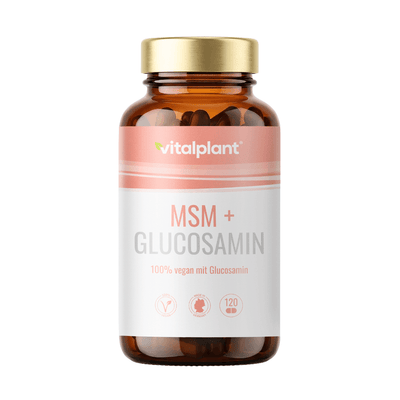
- MSM (methylsulfonylmethane) is an organic sulfur compound that occurs naturally in small amounts in foods — such as cow's milk, coffee, and some vegetables. Sulfur is a component of the amino acids cysteine and methionine. What MSM is chemically is explained in our MSM article.
- Glucosamine is an amino sugar and in the body a building block of cartilage tissue. It is usually obtained from shellfish shells — for vegan products it comes from mushroom fermentation.
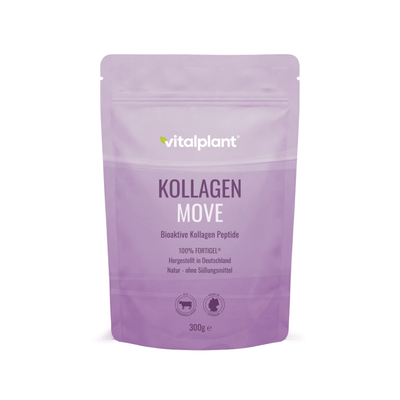
- Collagen is the most abundant structural protein in the body by quantity and the main component of cartilage, tendons, and ligaments. Nutritionally, it counts as a protein. More about types, peptide forms, and origin is on our page about collagen.
With all four, it pays to look at standardization: an extract without information on the marker substance cannot be compared with anything. Anyone putting two products side by side will find the difference there — not on the front.

When complaints should be medically assessed
This text is about maintaining normal mobility, not treating complaints. That distinction is not a formality:
- Joint pain that lasts longer than two weeks or gets worse
- Swelling, redness, or warmth in a joint
- Morning stiffness that lasts significantly longer than half an hour
- Restriction of movement that starts suddenly
- Pain with fever or a general feeling of illness
All of this belongs in medical hands — and first. Food supplements do not replace a diagnosis, and anyone taking products for months while a treatable cause remains undetected loses time.
A start that you can stick with
| When | What | Effort |
|---|---|---|
| Daily | Move every major joint once through its full range | 3 minutes |
| Daily | Walk for twenty to thirty minutes, preferably on uneven ground | the time you already have |
| Daily alongside other activities | Stand on one leg while brushing your teeth | no extra time |
| Twice a week | Strength: rising without hands, wall push-ups, calf raises — two sets each | 15 minutes |
| Ongoing | Make sure you get enough vitamin C, vitamin D, and calcium | — |
None of this is spectacular, and that's exactly the point. Mobility does not come from one measure, but from not neglecting a few unremarkable things over the years.
In short
- Mobility consists of three systems: joints, muscles, and balance. The third is almost always overlooked.
- Cartilage has no blood vessels — it is supplied through the cycle of loading and unloading. Rest is therefore rarely the right answer.
- The range of motion you regularly use is the one you keep.
- Vitamin C is at the start of collagen formation and thus contributes to the normal function of cartilage. Added to this are vitamin D, calcium, magnesium, and vitamin K for bones and muscles.
- For extracts such as frankincense, standardization to the marker substance determines whether two products can be compared at all.
- Persistent or sudden complaints should be medically assessed — first, not last.
Food supplements are not a substitute for a varied diet and a healthy lifestyle. If complaints persist, the cause should be medically assessed.