Creatine Powder

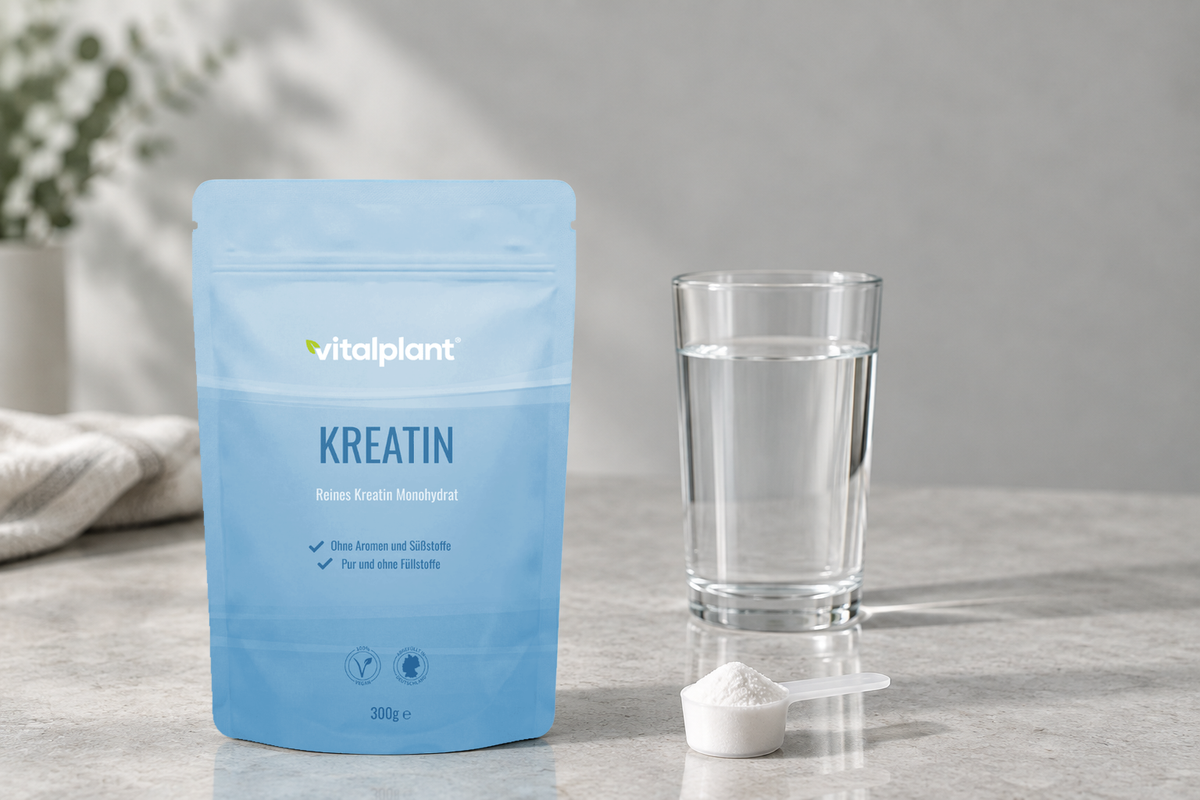
Creatine powder provides 5 g of creatine monohydrate per serving, including 4.4 g of creatine. The pure powder is mixed with water, juice, or a protein shake. 300 g yields 60 servings. Lab-tested from the Memmingen pharmacist workshop.

€19,90

€66,33 kg
Tax included.
Shipping calculated at checkout.

In stock - Arrives in 2-3 working days!

Size: 300g

Pay securely with PayPal Klarna Visa Mastercard Apple Pay Google Pay American Express

All payment methods

  • PayPalPayPal
  • KlarnaKlarna
  • Visa Visa
  • Mastercard Mastercard
  • Apple Pay Apple Pay
  • Google Pay Google Pay
  • American Express American Express
  • BizumBizum
  • EPS eps
  • iDEAL WeroIdeal
  • MaestroMaestro
  • Shop Pay Shop Pay
  • Union PayUnionPay

Payment is SSL encrypted via Shopify Checkout.

Why 5 g of monohydrate becomes 4.4 g of creatine

Vitalplant creatine powder consists of pure creatine monohydrate. The name already explains why the two numbers on the pack differ: monohydrate means that one water molecule is bound to each creatine molecule.

Creatine has a molar mass of 131.1, monohydrate 149.2. Calculating the ratio shows that 87.9 percent of the mass is creatine itself. One scoop of monohydrate therefore yields 4.4 g of creatine. Anyone comparing creatine products should look at this second number, not the first.

What is authorised and what applies to it

For creatine, there are two health claims approved in the EU, and both are tied to clear conditions.

Creatine increases physical performance during speed-strength training in the context of short-term intense physical exertion. The positive effect is achieved with a daily intake of 3 g of creatine. The claim is intended for adults who perform intense physical activity.

Daily creatine intake can improve the effect of strength training on muscle strength in adults over 55 years of age. Here too, the rule is: 3 g of creatine daily, in combination with strength training that allows an increase in muscle exertion over time, at least three times a week over several weeks and at an intensity of at least 65 to 75 percent of the one-repetition maximum.

Both claims therefore require training. Without a training stimulus, there is nothing to enhance.

Monohydrate and the amount in food

Creatine occurs naturally in meat and fish, in beef at roughly 4 to 5 g per kilogram of raw muscle meat. One serving of this powder therefore corresponds to roughly the creatine content of one kilo of raw beef steak.

Monohydrate is the form named in the approved claims and the one that underpins by far the largest share of the available studies. It is also the simplest and most affordable option.

Purity and processing

One ingredient, no flavouring, no sweetener, no anti-caking agent. The powder is practically tasteless and dissolves in 300 ml of liquid without residue. Not intended for children and teenagers, but expressly for adults. If you already take our Pre Workout+ you should know that it already contains 4 g of creatine monohydrate per serving.

Behind Vitalplant stands Christian Lazar, licensed pharmacist with over 35 years of professional experience at Stern Apotheke.

Inhalte zuletzt geprüft am

Creatine Monohydrate.

Nährwerte

Header: Average contentper 100 g
Creatine monohydrate100 g
of which creatine88 g

Recommended use: Mix 5 g powder (1 scoop) with 300 ml liquid, e.g. water, juice, or a protein shake, and consume.

Important information: Food supplements are not a substitute for a balanced and varied diet and lifestyle. The stated recommended daily intake must not be exceeded. Keep out of reach of young children.

Allergens: According to the raw material specification, no allergens requiring labeling pursuant to Annex II of Regulation (EU) No. 1169/2011 are included.

Storage: Store in a cool, dry place, do not freeze, and protect from direct sunlight.

The body produces it itself

Creatine is not an unnatural substance. It is formed in the liver, kidneys, and pancreas from the amino acids glycine, arginine, and methionine, at a rate of about one gram per day.

The rest comes from food, specifically exclusively from meat and fish. Plant-based foods contain practically none, which is why intake is lower from the outset on vegetarian and vegan diets. When frying and cooking, some of it also ends up in the cooking water.

How creatine is made

Unlike amino acids, creatine is not fermented but chemically synthesized, usually from sarcosine and cyanamide. It is then recrystallized from water, forming the monohydrate.

Purity is important here, because this process can produce by-products, above all dicyandiamide and creatinine. Good raw materials set maximum limits for this and list them in the certificate of analysis. For a single-ingredient product, that is the actual quality specification.

Why the shake should not be left standing

Creatine naturally turns into creatinine, a ring closure that cannot be reversed. In the body, this happens continuously, at a rate of about one to two percent of the total per day; creatinine is excreted through the kidneys and is therefore a common lab value in blood tests.

The same thing happens in the glass, and the warmer and more acidic the liquid, the faster it happens. In dry powder form, creatine is stable for years; dissolved in water, it is not. Mixing and drinking it right away is therefore more sensible than preparing a bottle for later in the day, and fruit juices are the less suitable choice because of their acidity.

Monohydrate and the other forms

The market offers numerous variants: creatine hydrochloride, buffered creatine, ethyl ester, creatine nitrate, magnesium chelate. They are usually advertised as more soluble or available in smaller servings, and they regularly cost more.

For classification, a glance at the regulation is enough: the two authorized health claims are tied to creatine, and the studies behind them were overwhelmingly conducted with monohydrate. It is also the simplest and most affordable form. Anyone who buys a more expensive variant is paying for a promise that goes beyond the current evidence.

Our creatine powder is manufactured to the highest quality standards and independently tested for heavy metals.

✔
Laboratory test - Download here!

✔ Product specification - Download here!

Creatine powder from Vitalplant in powder form, pure creatine monohydrate with no fillers.

€19,90

€66,33 kg

€19,90

€66,33 kg

Mix and drink

  • Kreatin Pulver - Kreatin-Monohydrat, sonst nichts

    Creatine monohydrate, nothing else

  • Kreatin Pulver - 5 g Monohydrat, 4,4 g Kreatin

    5 g monohydrate, 4.4 g creatine

  • Kreatin Pulver - 5 g in 300 ml Flüssigkeit

    5 g in 300 ml of liquid

Product reviews

Aus eigener Herstellung

  • Christian Lazar, Apotheker bei Vitalplant
    Vom Apotheker entwickelt Christian Lazar stellt jede Rezeptur selbst zusammen.
  • Pulver wird von Hand über die Kapselplatte abgestrichen
    Von Hand abgefüllt Kleine Chargen, jede Platte einzeln abgestrichen.
  • Kapselfüllgerät in der Herstellung
    Mechanisch dosiert Gleiche Menge in jeder einzelnen Kapsel.
  • Ohne künstliche ZusätzeKeine künstlichen Süßstoffe, Aromen oder Farbstoffe.
  • Geprüfte RohstoffeUnabhängig laborgeprüft, Analysenzertifikat auf jeder Seite.
  • Lichtgeschützt verpacktBraunglas oder blickdichter Beutel, je nach Produkt.
  • Kurze ZutatenlisteWas nicht hineingehört, steht auch nicht drin.

Frequently Asked Questions

Mix 5 g of powder, which is one measuring spoon, with 300 ml of liquid. Water, juice, or a protein shake all work equally well. The recommendation does not specify a fixed time; the important thing is that you take it every day.

Since monohydrate means that one water molecule is bound to each creatine molecule, creatine has a molar mass of 131.1, while the monohydrate is 149.2. If you calculate the ratio, 87.9 percent of the mass is creatine itself. Anyone comparing creatine products should look at this second figure, not the first.

Two claims are permitted in the EU. Creatine increases physical performance during high-speed strength training in short-term intense physical activity; the beneficial effect is obtained with a daily intake of 3 g of creatine, and the claim is intended for adults engaged in intense physical activity. Second: daily creatine intake may improve the effect of strength training on muscle strength in adults over 55 years of age.

It is subject to clear conditions: 3 g of creatine daily, together with strength training that allows an increase in muscle exertion over time, at least three times a week for several weeks and at an intensity of at least 65 to 75 percent of one-repetition maximum. Without this training, there is nothing to enhance.

Creatine occurs naturally in meat and fish, with beef containing around 4 to 5 g per kilogram of raw muscle meat. One serving of this powder therefore corresponds roughly to the creatine content of one kilo of raw beef steak. It is practically absent from plant-based foods.

Monohydrate is the form explicitly named in the approved claims and the one supported by by far the largest share of available studies. It is also the simplest and most affordable variant. Other forms are sold on the market, but they make little difference.

Creatine monohydrate is only partially water-soluble, which is why the recommended amount is 300 ml: in a small glass, some can quickly remain at the bottom. It dissolves better in warm liquid than in ice-cold liquid. Stir well and drink promptly instead of letting the glass sit.

The bag contains 300 g and, at 5 g per day, provides 60 servings, or two months. One ingredient, no flavoring, no sweetener, no anti-caking agent. Anyone taking our Pre Workout+ alongside it should know that it already contains 4 g of creatine monohydrate per serving.

General ratings from our customers